

Description
Xandre Store Exclusive - An Authenticated Historical Studio Work from the Kiyomasa Touki Tsuboya Tradition
- Artist: Kiyomasa Kobashigawa (小橋川 清正)
- Studio & Kiln Lineage: Kiyomasa Touki / Tsuboya Kiln (清正陶器・壺屋窯)
- Origin: Tsuboya Pottery District, Naha City, Okinawa Prefecture, Japan
- Category: Okinawan Yachimun Ceramic | Fine Art Tea Utensil | Collector Ceramic Trivet
- Form: Pot-Shiki / Nabe-Shiki — teapot stand / heat-resistant ceramic stand
- Craft Tradition: 壺屋焼 (Tsuboya-yaki) / Okinawan Yachimun
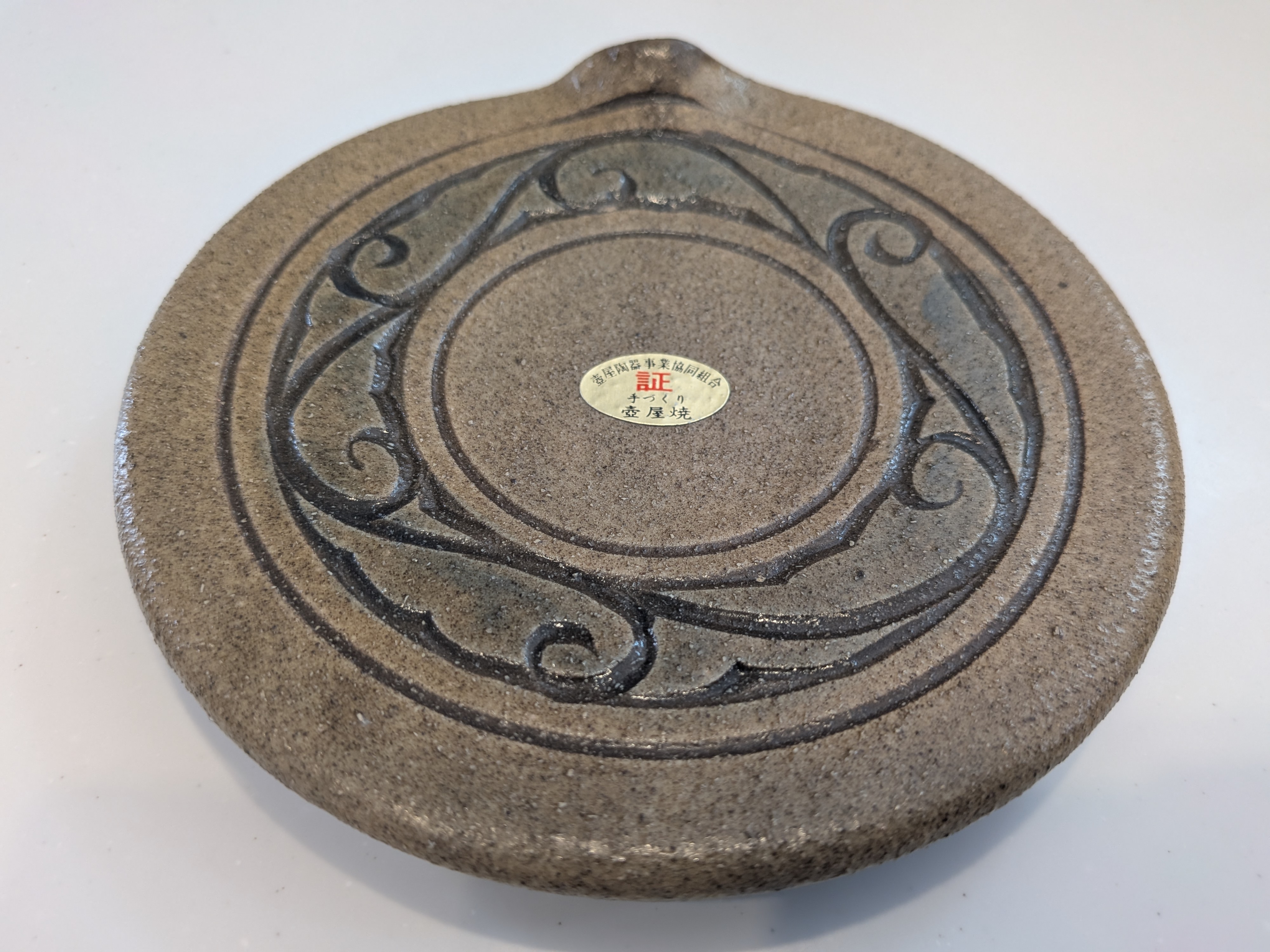
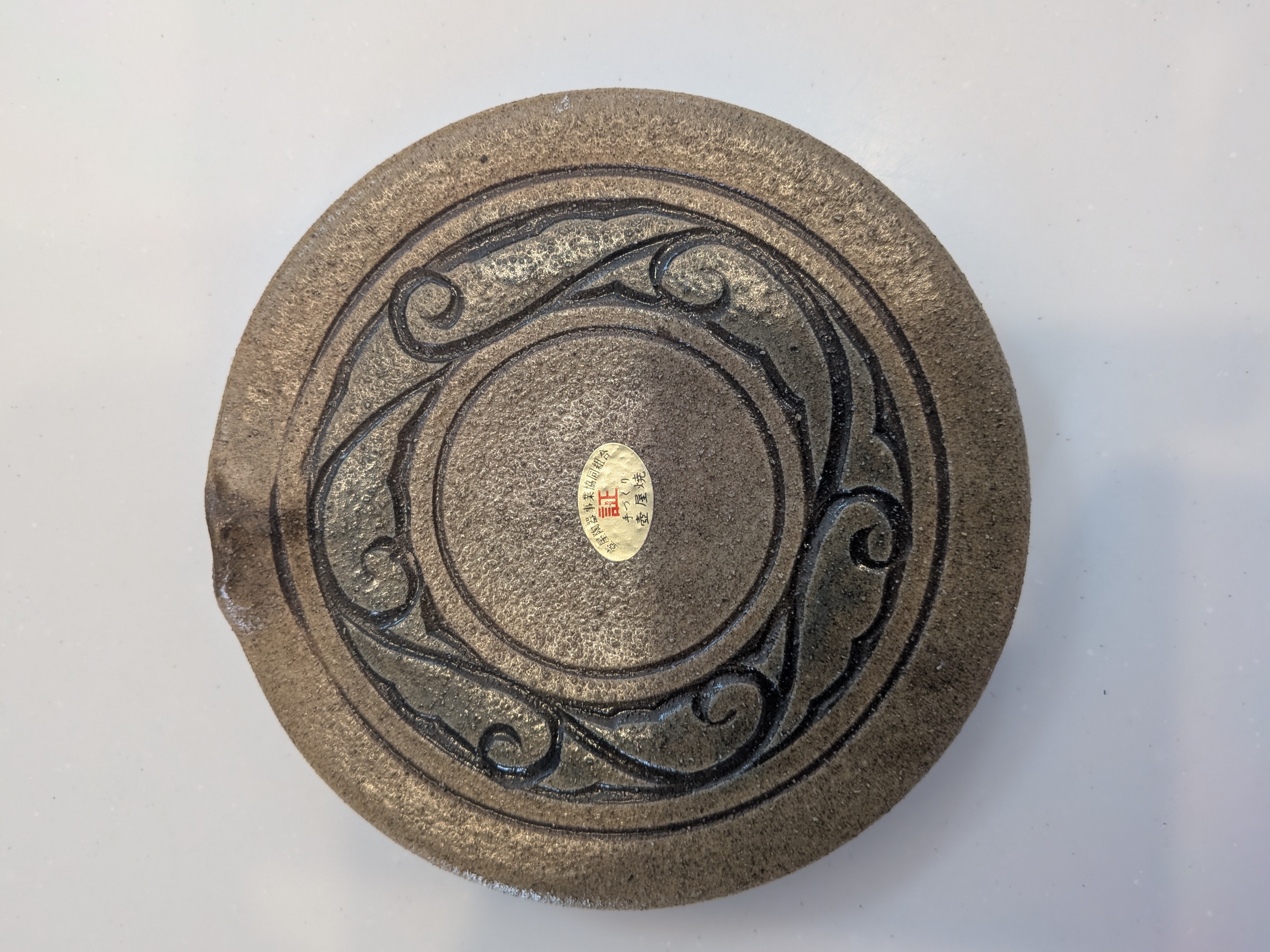
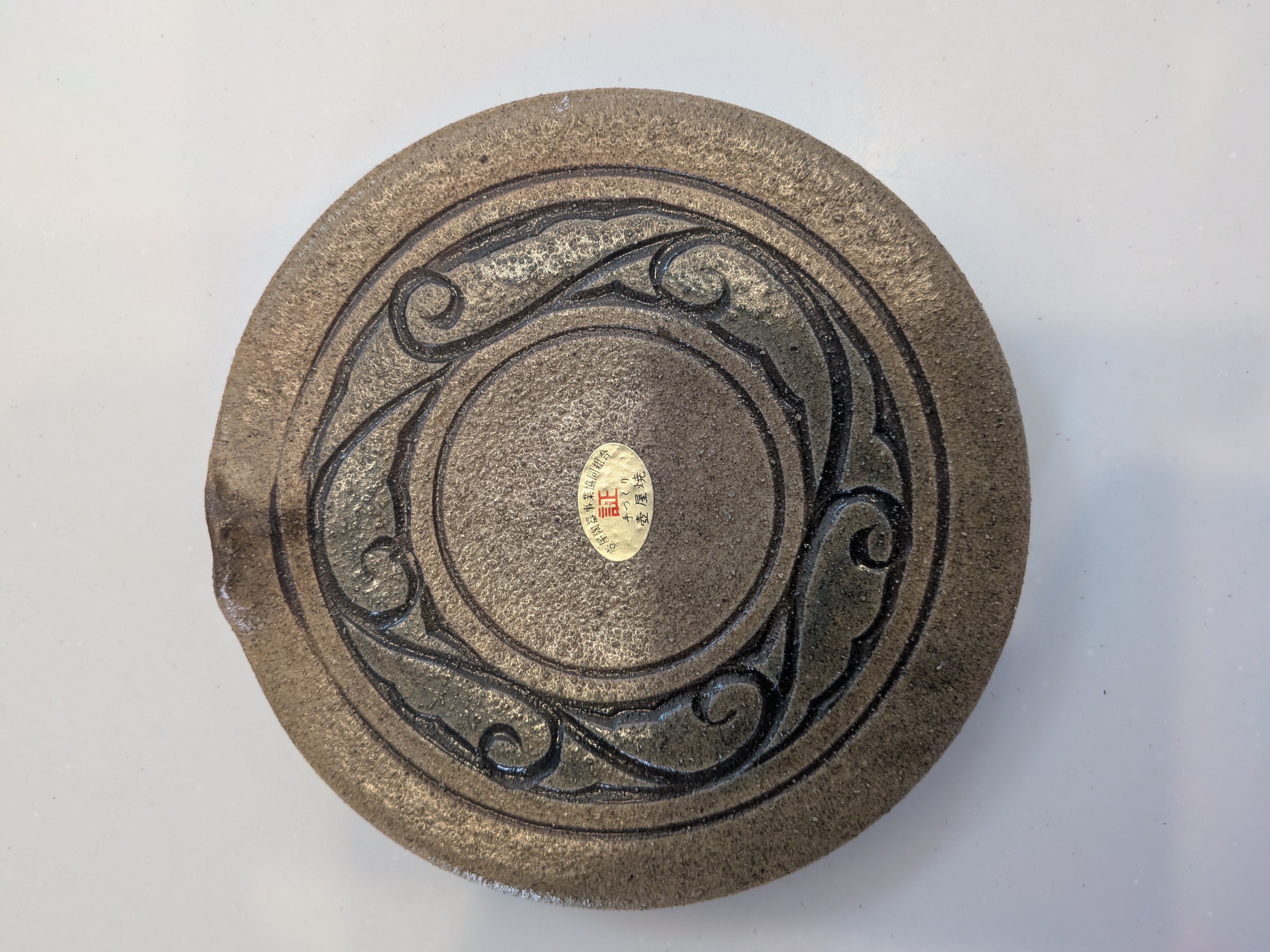
This substantial hand-carved ceramic teapot stand and trivet by Kiyomasa Kobashigawa (小橋川 清正) presents an especially functional yet sculptural expression of the historic Tsuboya ceramic tradition. Formed as a solid, weighty circular ceramic piece, the surface is decorated with an uninterrupted Karakusa (唐草) vine pattern, hand-carved into the clay and framed by concentric borders. The dark manganese-iron glaze produces a subdued metallic and mineral character, emphasizing the depth of the carving while allowing natural variations in the fired surface to remain visible.
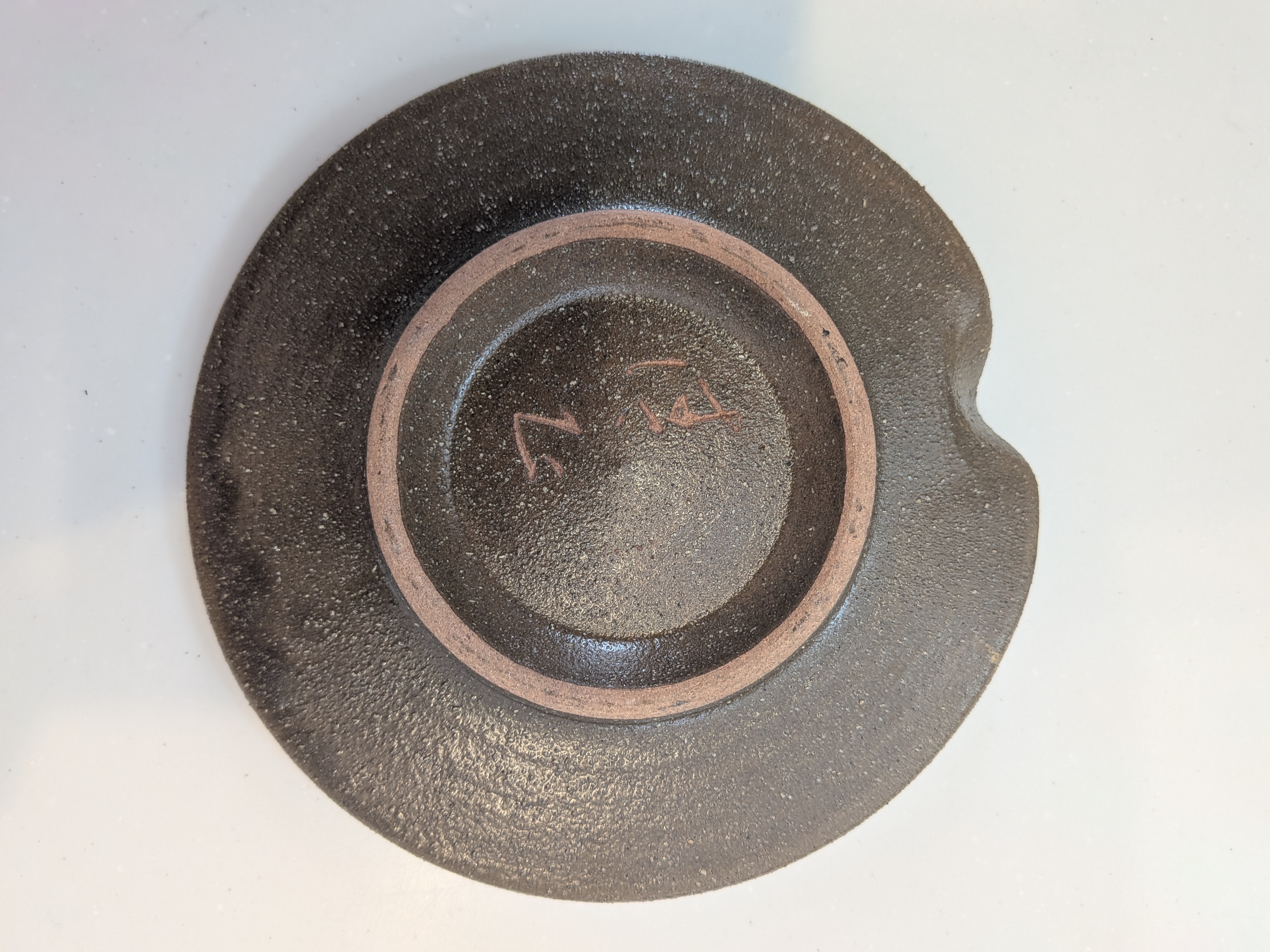
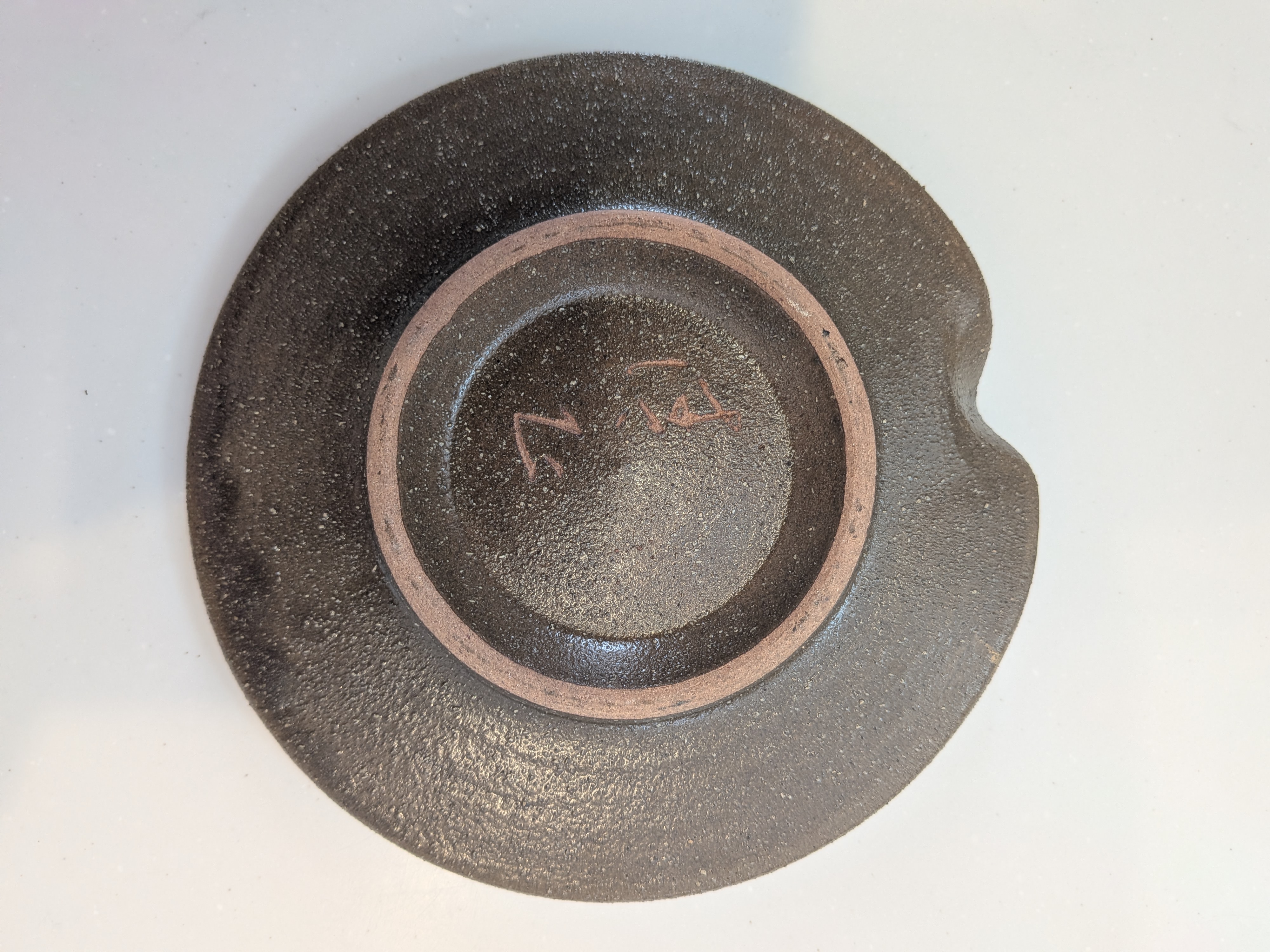
Designed as a Pot-Shiki / Nabe-Shiki, the object belongs to the broader tradition of Japanese ceramic tea and serving accessories, where substantial ceramic stands provide a stable surface for teapots, kettles, or other heated vessels. The underside provides particularly important identifying details. The piece bears a Tsuboya Pottery Cooperative identification label and Kobashigawa's hand-incised 「清」 (Kiyo) studio mark, giving collectors two visible points of provenance associated with the work. As the Kiyomasa Touki studio is no longer operating, an individually marked work such as this represents a finite example of the studio's historical production.
Kiyomasa Kobashigawa - Studio Heritage
Kiyomasa Kobashigawa (小橋川 清正) was a Tsuboya potter associated with the historic ceramic district of Naha, Okinawa. Through Kiyomasa Touki (清正陶器), his work continued the Tsuboya tradition of combining practical ceramic forms with strongly developed surface decoration and hand-applied character.His career is also associated with the 2000 Kyushu-Okinawa G8 Summit, held in Okinawa, an important event in the modern history of the prefecture and its cultural presentation.
For collectors, the significance of this piece lies not only in the artist attribution but in the combination of:
Kobashigawa's studio mark + Tsuboya Cooperative identification + traditional Tsuboya form + hand-carved decoration.
The Karakusa Motif
The principal decoration is the Karakusa (唐草), one of the most enduring decorative motifs in Japanese and East Asian art.
The continuously intertwined vine is visually associated with continuity, longevity, flourishing growth, and enduring lineage. Its uninterrupted movement is particularly effective when applied around a circular ceramic form, allowing the design to flow naturally around the surface.
Here, the motif is not merely painted onto the ceramic. It is physically carved into the clay, creating a changing relationship between light, shadow, and glaze.
The dark iron-manganese finish further emphasizes those carved recesses, giving the surface an architectural quality.
Technical Craftsmanship
1. Ceramic Form & Structural Preparation: Producing a relatively thick, flat ceramic form requires careful control during forming and drying. Uneven moisture loss can cause flat ceramics to warp or crack during firing.
2. Karakusa Relief Carving: The continuous vine design is individually carved into the clay while it remains workable. Maintaining consistent depth and flowing transitions around a circular surface requires considerable hand control.
3. Iron-Manganese Glazing: The dark iron-manganese glaze produces the characteristic charcoal, brown-black and metallic mineral appearance associated with the piece.
Variations in glaze thickness and kiln atmosphere can create subtle differences in sheen, pooling, and tonal density.
4. High-Temperature Firing: The completed ceramic must withstand substantial thermal stress during firing. The resulting surface combines the permanence of fired stoneware with the visual irregularities that distinguish handmade ceramics from industrial production.
Historical & Cultural Context
The Pot-Shiki / Nabe-Shiki format occupies an interesting position between functional Japanese tableware and studio ceramics. Rather than being designed solely as a decorative object, the form was intended to serve a practical purpose: providing a stable ceramic surface beneath heated cookware or teaware. This dual character makes the work particularly appropriate for collectors interested in Japanese tea culture, Okinawan Yachimun, and functional studio ceramics. The Karakusa decoration also gives the otherwise utilitarian form an ornamental dimension, transforming a practical accessory into an object suitable for display.
Premium Collector Highlights
- Artist: Kiyomasa Kobashigawa (小橋川 清正)
- Historic Studio: Kiyomasa Touki / Tsuboya Kiln (清正陶器・壺屋窯)
- Traditional Form: Ceramic Pot-Shiki / Nabe-Shiki
- Decoration: Hand-carved Karakusa vine pattern
- Glaze: Dark iron-manganese / ash-derived mineral finish
- Authentication: Tsuboya Pottery Cooperative identification label
- Artist Mark: Hand-incised 「清」 signature on the base
- Origin: Historic Tsuboya district, Naha, Okinawa
- Studio Status: Historical studio no longer operating
- Collector Character: Individually crafted and marked historical studio work
Curator's Note
The strength of this piece comes from the relationship between function and decoration. Its substantial ceramic body gives it the physical presence expected from a traditional teapot stand, while the continuous Karakusa carving transforms the surface into a study in rhythm, shadow, and movement.
The dark manganese-iron finish provides a restrained backdrop for the carving, allowing the changing depth of the vine pattern to become the principal visual element. Combined with Kobashigawa's 「清」 studio mark and the accompanying Tsuboya Cooperative identification, the piece provides collectors with a particularly tangible example of the Kiyomasa Touki tradition.
Specifications
| Attribute | Details |
| Artist | Kiyomasa Kobashigawa (小橋川 清正) |
| Studio & Kiln | Kiyomasa Touki / Tsuboya Kiln (清正陶器・壺屋窯) |
| Origin | Tsuboya, Naha City, Okinawa, Japan |
| Category | Okinawan Tsuboya-yaki / Yachimun / Fine Art Tea Utensil |
| Form | Ceramic Teapot Stand / Trivet (Pot-Shiki / Nabe-Shiki) |
| Motif | Intertwined Karakusa Vine (唐草) |
| Materials | Okinawan ceramic clay with mineral-based iron-manganese glaze |
| Technique | Hand-forming, hand-carved relief decoration and high-temperature firing |
| Surface | Deep carved Karakusa pattern with dark mineral glaze |
| Authentication | Tsuboya Cooperative identification label |
| Artist Mark | Hand-incised 「清」 studio mark on base |
| Era | Historical late-20th-century studio production |
| Studio Status | Kiyomasa Touki — historical studio no longer operating |
| Condition | Excellent vintage studio condition |
Care Instructions
- Handle carefully by supporting the main ceramic body.
- Clean with a soft, dry or slightly damp cloth.
- Use a soft brush to remove dust from carved recesses.
- Avoid abrasive pads, wire brushes, and strong chemical cleaners.
- Do not place in a dishwasher.
- Avoid prolonged soaking.
- Allow the piece to dry completely before storage.
- If used beneath heated cookware, avoid sudden extreme temperature changes.
Shipping & International Delivery
Domestic Japan: Shipped using insured delivery and protective double-box packaging appropriate for ceramic artwork.
International: International delivery is available with protective packaging selected for the weight and ceramic construction of the piece.
Destination-country customs duties, VAT, GST, import taxes, and customs clearance charges, where applicable, remain the responsibility of the recipient.
Description
Xandre Store Exclusive - An Authenticated Historical Studio Work from the Kiyomasa Touki Tsuboya Tradition
- Artist: Kiyomasa Kobashigawa (小橋川 清正)
- Studio & Kiln Lineage: Kiyomasa Touki / Tsuboya Kiln (清正陶器・壺屋窯)
- Origin: Tsuboya Pottery District, Naha City, Okinawa Prefecture, Japan
- Category: Okinawan Yachimun Ceramic | Fine Art Tea Utensil | Collector Ceramic Trivet
- Form: Pot-Shiki / Nabe-Shiki — teapot stand / heat-resistant ceramic stand
- Craft Tradition: 壺屋焼 (Tsuboya-yaki) / Okinawan Yachimun
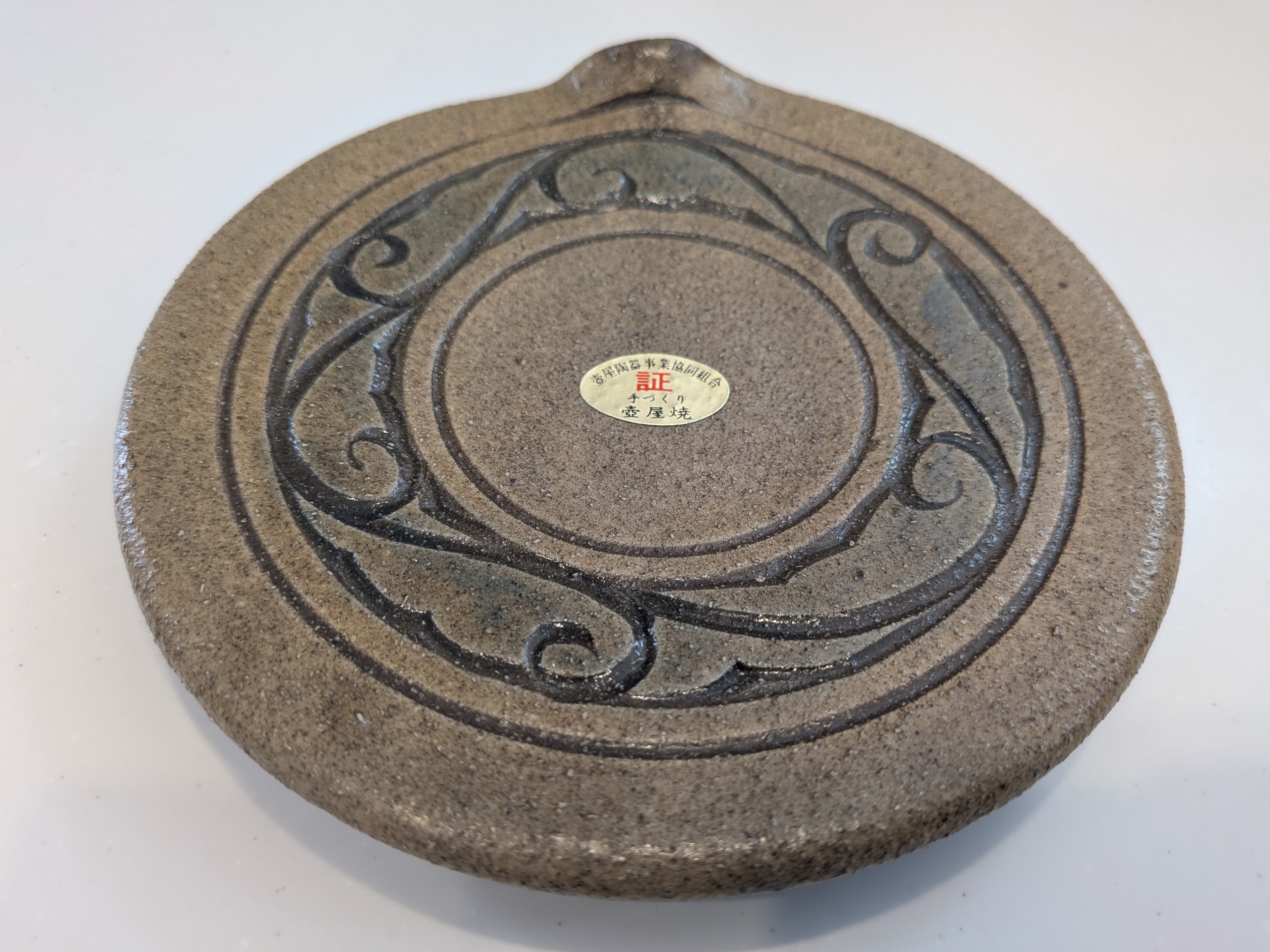
This substantial hand-carved ceramic teapot stand and trivet by Kiyomasa Kobashigawa (小橋川 清正) presents an especially functional yet sculptural expression of the historic Tsuboya ceramic tradition. Formed as a solid, weighty circular ceramic piece, the surface is decorated with an uninterrupted Karakusa (唐草) vine pattern, hand-carved into the clay and framed by concentric borders. The dark manganese-iron glaze produces a subdued metallic and mineral character, emphasizing the depth of the carving while allowing natural variations in the fired surface to remain visible.
Designed as a Pot-Shiki / Nabe-Shiki, the object belongs to the broader tradition of Japanese ceramic tea and serving accessories, where substantial ceramic stands provide a stable surface for teapots, kettles, or other heated vessels. The underside provides particularly important identifying details. The piece bears a Tsuboya Pottery Cooperative identification label and Kobashigawa's hand-incised 「清」 (Kiyo) studio mark, giving collectors two visible points of provenance associated with the work. As the Kiyomasa Touki studio is no longer operating, an individually marked work such as this represents a finite example of the studio's historical production.
Kiyomasa Kobashigawa - Studio Heritage
Kiyomasa Kobashigawa (小橋川 清正) was a Tsuboya potter associated with the historic ceramic district of Naha, Okinawa. Through Kiyomasa Touki (清正陶器), his work continued the Tsuboya tradition of combining practical ceramic forms with strongly developed surface decoration and hand-applied character.His career is also associated with the 2000 Kyushu-Okinawa G8 Summit, held in Okinawa, an important event in the modern history of the prefecture and its cultural presentation.
For collectors, the significance of this piece lies not only in the artist attribution but in the combination of:
Kobashigawa's studio mark + Tsuboya Cooperative identification + traditional Tsuboya form + hand-carved decoration.
The Karakusa Motif
The principal decoration is the Karakusa (唐草), one of the most enduring decorative motifs in Japanese and East Asian art.
The continuously intertwined vine is visually associated with continuity, longevity, flourishing growth, and enduring lineage. Its uninterrupted movement is particularly effective when applied around a circular ceramic form, allowing the design to flow naturally around the surface.
Here, the motif is not merely painted onto the ceramic. It is physically carved into the clay, creating a changing relationship between light, shadow, and glaze.
The dark iron-manganese finish further emphasizes those carved recesses, giving the surface an architectural quality.
Technical Craftsmanship
1. Ceramic Form & Structural Preparation: Producing a relatively thick, flat ceramic form requires careful control during forming and drying. Uneven moisture loss can cause flat ceramics to warp or crack during firing.
2. Karakusa Relief Carving: The continuous vine design is individually carved into the clay while it remains workable. Maintaining consistent depth and flowing transitions around a circular surface requires considerable hand control.
3. Iron-Manganese Glazing: The dark iron-manganese glaze produces the characteristic charcoal, brown-black and metallic mineral appearance associated with the piece.
Variations in glaze thickness and kiln atmosphere can create subtle differences in sheen, pooling, and tonal density.
4. High-Temperature Firing: The completed ceramic must withstand substantial thermal stress during firing. The resulting surface combines the permanence of fired stoneware with the visual irregularities that distinguish handmade ceramics from industrial production.
Historical & Cultural Context
The Pot-Shiki / Nabe-Shiki format occupies an interesting position between functional Japanese tableware and studio ceramics. Rather than being designed solely as a decorative object, the form was intended to serve a practical purpose: providing a stable ceramic surface beneath heated cookware or teaware. This dual character makes the work particularly appropriate for collectors interested in Japanese tea culture, Okinawan Yachimun, and functional studio ceramics. The Karakusa decoration also gives the otherwise utilitarian form an ornamental dimension, transforming a practical accessory into an object suitable for display.
Premium Collector Highlights
- Artist: Kiyomasa Kobashigawa (小橋川 清正)
- Historic Studio: Kiyomasa Touki / Tsuboya Kiln (清正陶器・壺屋窯)
- Traditional Form: Ceramic Pot-Shiki / Nabe-Shiki
- Decoration: Hand-carved Karakusa vine pattern
- Glaze: Dark iron-manganese / ash-derived mineral finish
- Authentication: Tsuboya Pottery Cooperative identification label
- Artist Mark: Hand-incised 「清」 signature on the base
- Origin: Historic Tsuboya district, Naha, Okinawa
- Studio Status: Historical studio no longer operating
- Collector Character: Individually crafted and marked historical studio work
Curator's Note
The strength of this piece comes from the relationship between function and decoration. Its substantial ceramic body gives it the physical presence expected from a traditional teapot stand, while the continuous Karakusa carving transforms the surface into a study in rhythm, shadow, and movement.
The dark manganese-iron finish provides a restrained backdrop for the carving, allowing the changing depth of the vine pattern to become the principal visual element. Combined with Kobashigawa's 「清」 studio mark and the accompanying Tsuboya Cooperative identification, the piece provides collectors with a particularly tangible example of the Kiyomasa Touki tradition.
Specifications
| Attribute | Details |
| Artist | Kiyomasa Kobashigawa (小橋川 清正) |
| Studio & Kiln | Kiyomasa Touki / Tsuboya Kiln (清正陶器・壺屋窯) |
| Origin | Tsuboya, Naha City, Okinawa, Japan |
| Category | Okinawan Tsuboya-yaki / Yachimun / Fine Art Tea Utensil |
| Form | Ceramic Teapot Stand / Trivet (Pot-Shiki / Nabe-Shiki) |
| Motif | Intertwined Karakusa Vine (唐草) |
| Materials | Okinawan ceramic clay with mineral-based iron-manganese glaze |
| Technique | Hand-forming, hand-carved relief decoration and high-temperature firing |
| Surface | Deep carved Karakusa pattern with dark mineral glaze |
| Authentication | Tsuboya Cooperative identification label |
| Artist Mark | Hand-incised 「清」 studio mark on base |
| Era | Historical late-20th-century studio production |
| Studio Status | Kiyomasa Touki — historical studio no longer operating |
| Condition | Excellent vintage studio condition |
Care Instructions
- Handle carefully by supporting the main ceramic body.
- Clean with a soft, dry or slightly damp cloth.
- Use a soft brush to remove dust from carved recesses.
- Avoid abrasive pads, wire brushes, and strong chemical cleaners.
- Do not place in a dishwasher.
- Avoid prolonged soaking.
- Allow the piece to dry completely before storage.
- If used beneath heated cookware, avoid sudden extreme temperature changes.
Shipping & International Delivery
Domestic Japan: Shipped using insured delivery and protective double-box packaging appropriate for ceramic artwork.
International: International delivery is available with protective packaging selected for the weight and ceramic construction of the piece.
Destination-country customs duties, VAT, GST, import taxes, and customs clearance charges, where applicable, remain the responsibility of the recipient.
Previously viewed products
No recently viewed products.