

Description
Xandre Store Exclusive - An Authenticated Historical Studio Work from the Kiyomasa Touki Tsuboya Tradition
- Artist: Kiyomasa Kobashigawa (小橋川 清正)
- Studio & Kiln Lineage: Kiyomasa Touki / Tsuboya Kiln (清正陶器・壺屋窯)
- Origin: Tsuboya Pottery District, Naha City, Okinawa Prefecture, Japan
- Category: Okinawan Yachimun Ceramic | Fine Art Small Dish | Collector Relief-Carved Plate
- Form: Mokkō-zara / foliate small dish (魚紋木瓜皿)
- Craft Tradition: 壺屋焼 (Tsuboya-yaki) / Okinawan Yachimun
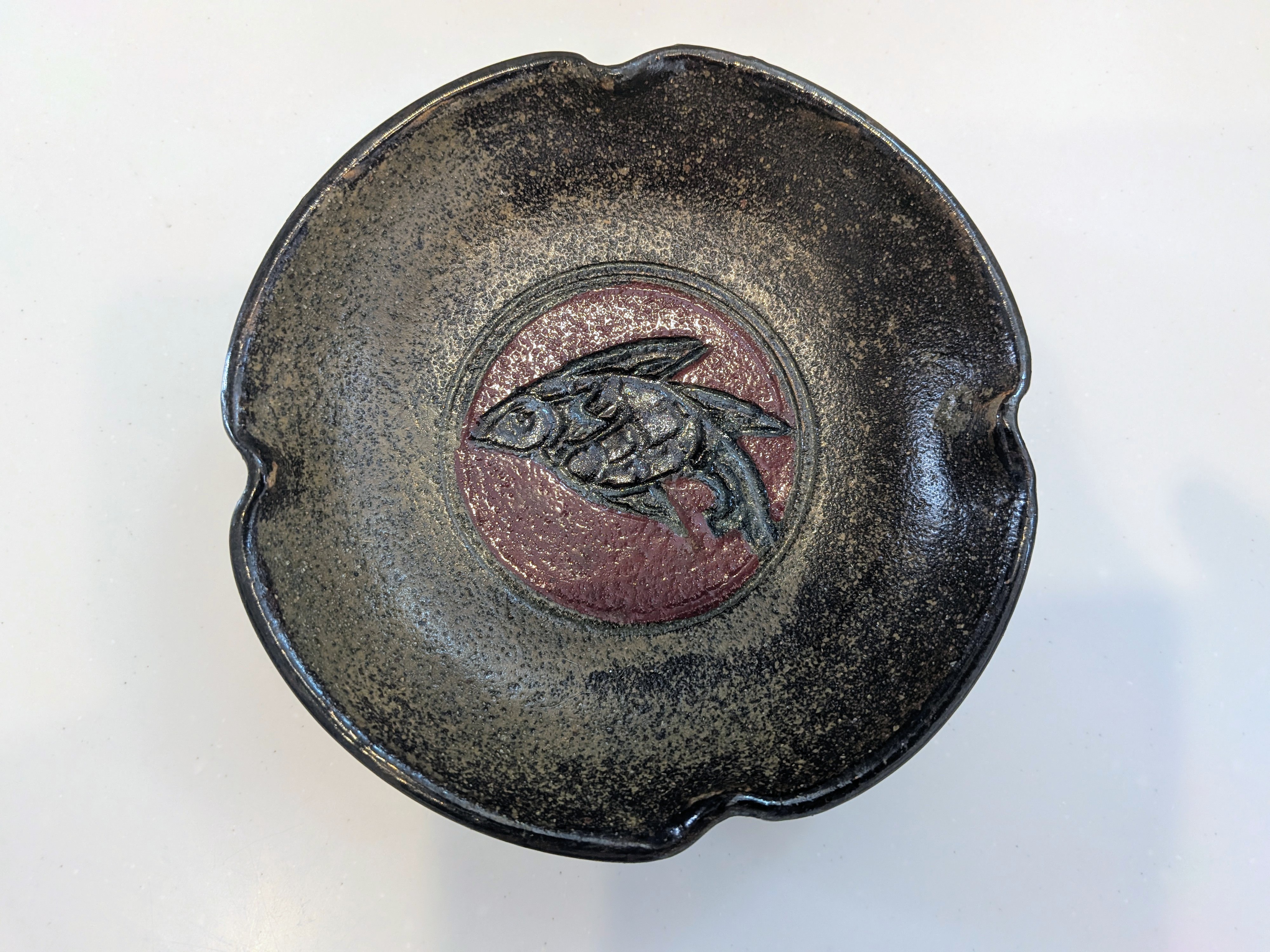
This finely detailed relief-carved foliate small dish (Mokkō-zara) by Kiyomasa Kobashigawa (小橋川 清正) presents a highly tactile example of late-20th-century Okinawan Yachimun craftsmanship. The dish combines a softly lobed, petal-like silhouette with a central fish motif (Gyomon), hand-carved directly into the clay and accented with rich iron-red slip and dark cobalt-toned decoration. Surrounding the central medallion is a restrained olive-charcoal surface with natural tonal variation, creating a strong contrast between the vivid central decoration and the darker outer field.
Its relatively compact format makes the piece particularly intimate: the relief can be appreciated not only visually but through the substantial ceramic body and carefully articulated carving.
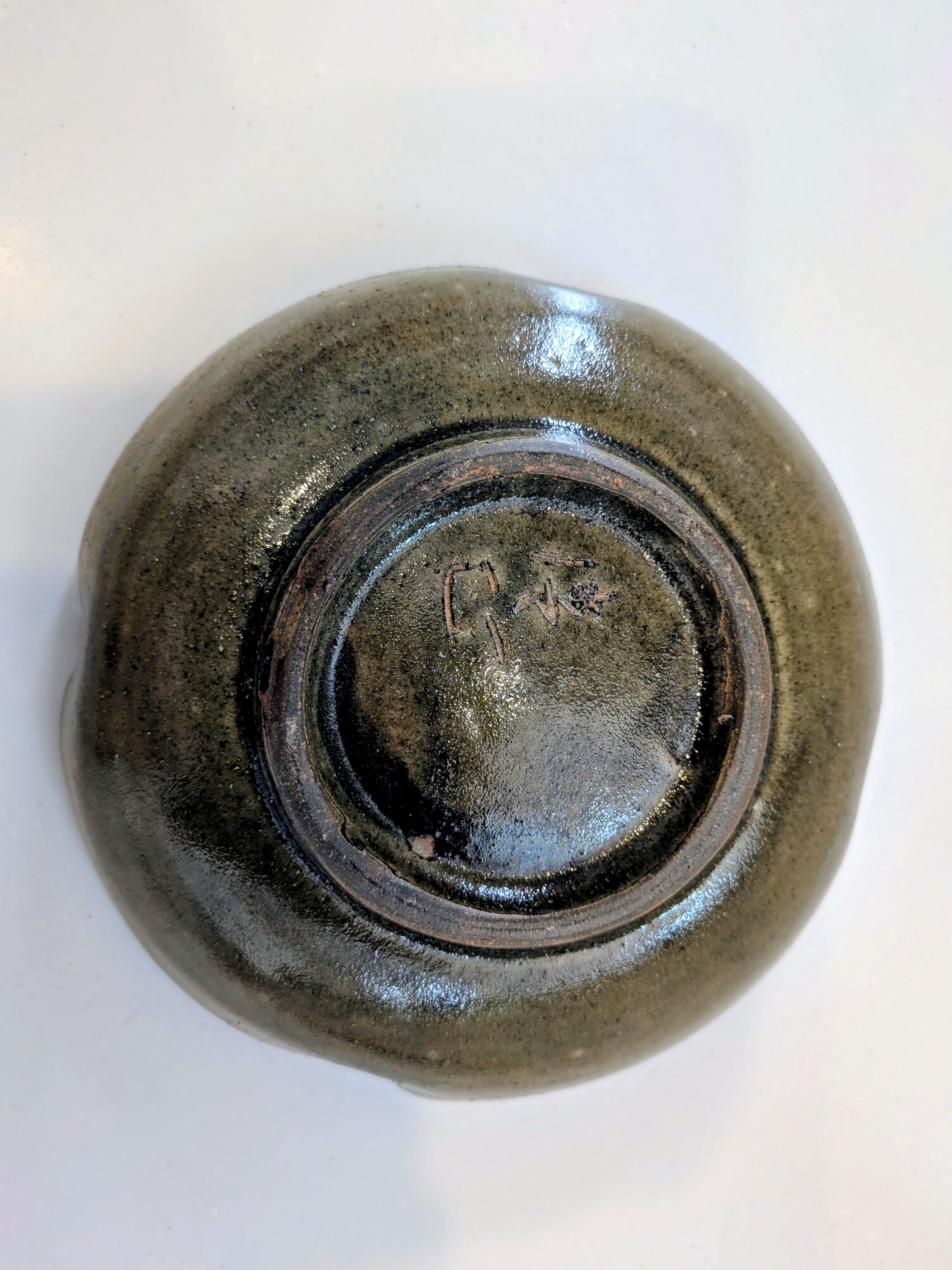
The underside bears Kobashigawa's hand-incised 「清」 (Kiyo) studio mark, providing an important identifying feature for collectors. The piece is presented by Xandre Store as an individual historical studio work rather than as a contemporary reproduction.
Master Kiyomasa Kobashigawa - Studio Heritage
Kiyomasa Kobashigawa (小橋川 清正) was associated with the historic Tsuboya pottery tradition of Naha, Okinawa, and operated through Kiyomasa Touki (清正陶器).
His work belongs to a period when Okinawan ceramic artists continued to reinterpret traditional Tsuboya forms, decorative motifs, and mineral-based surfaces for modern collectors and functional use.
Kobashigawa's association with the 2000 Kyushu-Okinawa G8 Summit is an important part of the documented history surrounding his career. His participation in work associated with the summit places his studio within a notable chapter of modern Okinawan ceramic history.
With the Kiyomasa Touki studio no longer operating, works carrying the artist's identifying mark represent a finite body of historical studio production.
The Fish Motif - Gyomon
The central fish decoration is one of the most recognizable visual traditions associated with Okinawan Yachimun. Fish imagery (Gyomon) is strongly associated with the maritime environment of Okinawa and is commonly interpreted in Okinawan decorative arts through themes of abundance, prosperity, vitality, and connection to the sea.
Rather than presenting the fish as a flat painted illustration, Kobashigawa integrates the motif into the ceramic surface through relief carving. This creates shadows and changes in texture as light moves across the dish. The result is a decoration that is simultaneously graphic, sculptural, and tactile.
The Mokkō Form
The dish's lobed outline gives it the characteristic appearance of a Mokkō-style foliate form.
The gently indented perimeter creates four principal lobes that visually frame the central medallion. This structure allows the fish motif to function almost like a miniature ceramic painting surrounded by a sculptural border.
For collectors, the combination of:
- Mokkō foliate form
- Gyomon fish decoration
- Akae-style red mineral coloration
- deep relief carving
- Kobashigawa's 「清」 signature
creates a particularly distinctive representation of the artist's decorative vocabulary.
Technical Craftsmanship
The creation of a small relief-carved dish requires considerable control despite its modest dimensions.
1. Forming the Body: The clay body must be shaped to establish an even thickness and stable profile before the decorative work begins.
2. Creating the Foliate Rim: The perimeter is carefully manipulated to create the symmetrical Mokkō-style lobing without compromising the dish's structural balance.
3. Relief Carving: The fish motif is carved into leather-hard clay using controlled hand pressure. On a small surface, even minor deviations can substantially affect the final composition.
4. Pigment & Glaze Application: Iron-rich red decoration and darker blue/cobalt-toned accents create the principal color contrast, while the surrounding darker glaze establishes depth around the central motif.
5. Firing: The completed work must withstand drying and kiln firing without significant warping, cracking, or distortion—particularly important for a shallow, lobed ceramic form.
Premium Collector Highlights
- Master Artist: Kiyomasa Kobashigawa (小橋川 清正)
- Historic Studio: Kiyomasa Touki / Tsuboya Kiln
- Traditional Form: Mokkō-zara (木瓜皿)
- Decorative Motif: Hand-carved Gyomon (魚紋)
- Technique: Relief carving (Senbori) with mineral-slip and glaze decoration
- Signature: Hand-incised 「清」 mark on the base
- Material: Okinawan ceramic clay with mineral-based decorative finishes
- Historical Period: Late 20th-century studio production
- Studio Status: Kiyomasa Touki is no longer operating
- Collector Character: Individual historical studio work with non-repeatable hand-carved decoration
Curator's Note
Small-format ceramics can reveal an artist's discipline particularly clearly. On this dish, the lobed Mokkō silhouette establishes a precise frame for the central fish motif, while the relief carving gives the decoration depth that changes with the surrounding light.
The contrast between the red central field, dark fish decoration, and subdued outer glaze gives the piece a distinctly Okinawan character. Combined with Kobashigawa's 「清」 studio mark and the now-closed Kiyomasa Touki lineage, the work offers collectors a compact and highly tactile example of modern Tsuboya ceramic craftsmanship.
Specifications
| Attribute | Details |
| Artist | Kiyomasa Kobashigawa (小橋川 清正) |
| Studio & Kiln | Kiyomasa Touki / Tsuboya Kiln (清正陶器・壺屋窯) |
| Origin | Tsuboya, Naha City, Okinawa, Japan |
| Category | Okinawan Tsuboya-yaki / Fine Art Collector Ceramic |
| Form | Foliate Small Dish / Mokkō-zara (魚紋木瓜皿) |
| Motif | Hand-carved Fish / Gyomon (魚紋) |
| Materials | Okinawan ceramic clay, mineral red slip, cobalt-toned decoration, glaze |
| Technique | Hand-forming, foliate rim shaping, relief carving and glazed decoration |
| Surface | Relief-carved central medallion with contrasting outer glaze |
| Markings | Hand-incised 「清」 studio mark on base |
| Era | Late 20th-century studio production |
| Studio Status | Kiyomasa Touki — historical studio no longer operating |
| Condition | Excellent vintage studio condition |
Care Instructions
- Handle gently by supporting the main body.
- Dust with a soft, dry microfiber cloth or soft brush.
- For occasional cleaning, use a slightly damp soft cloth and dry immediately.
- Avoid abrasive pads, wire brushes, and strong chemical cleaners.
- Do not place in a dishwasher or microwave.
- Avoid prolonged soaking.
- Keep away from sudden temperature changes and accidental impact.
Shipping & International Delivery
Domestic Japan: Insured shipping with protective double-box packaging.
International: Carefully protected international shipment is available. Destination-country customs duties, VAT, GST, import taxes, and customs clearance charges, where applicable, remain the responsibility of the recipient.
Because this is an individual historical ceramic work, Xandre Store will use protective packaging appropriate for its size, shape, and carved surface.
Xandre Store
Connecting global collectors with the craftsmanship, heritage, and stories behind Japan's finest regional studio traditions.
Description
Xandre Store Exclusive - An Authenticated Historical Studio Work from the Kiyomasa Touki Tsuboya Tradition
- Artist: Kiyomasa Kobashigawa (小橋川 清正)
- Studio & Kiln Lineage: Kiyomasa Touki / Tsuboya Kiln (清正陶器・壺屋窯)
- Origin: Tsuboya Pottery District, Naha City, Okinawa Prefecture, Japan
- Category: Okinawan Yachimun Ceramic | Fine Art Small Dish | Collector Relief-Carved Plate
- Form: Mokkō-zara / foliate small dish (魚紋木瓜皿)
- Craft Tradition: 壺屋焼 (Tsuboya-yaki) / Okinawan Yachimun
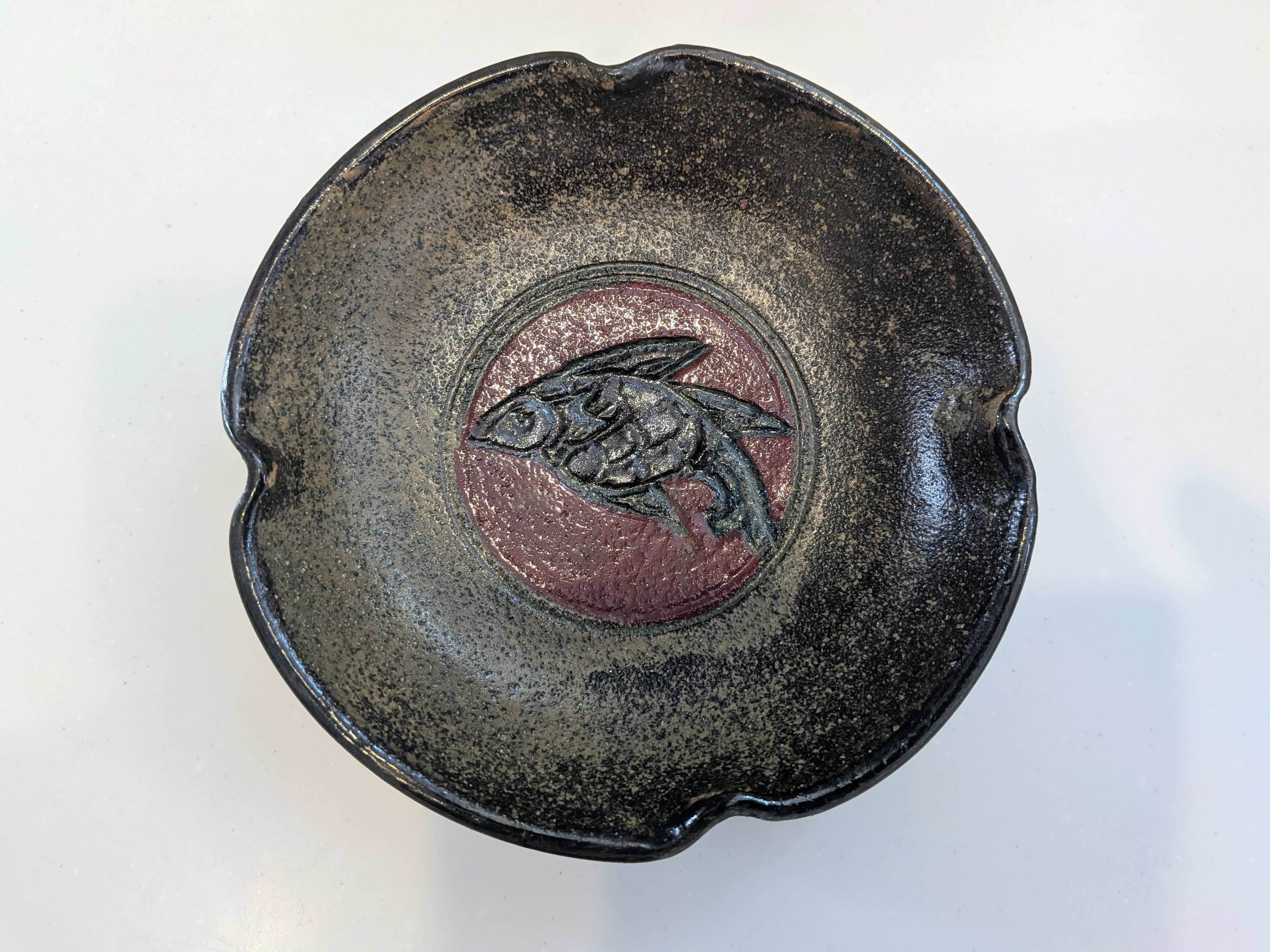
This finely detailed relief-carved foliate small dish (Mokkō-zara) by Kiyomasa Kobashigawa (小橋川 清正) presents a highly tactile example of late-20th-century Okinawan Yachimun craftsmanship. The dish combines a softly lobed, petal-like silhouette with a central fish motif (Gyomon), hand-carved directly into the clay and accented with rich iron-red slip and dark cobalt-toned decoration. Surrounding the central medallion is a restrained olive-charcoal surface with natural tonal variation, creating a strong contrast between the vivid central decoration and the darker outer field.
Its relatively compact format makes the piece particularly intimate: the relief can be appreciated not only visually but through the substantial ceramic body and carefully articulated carving.
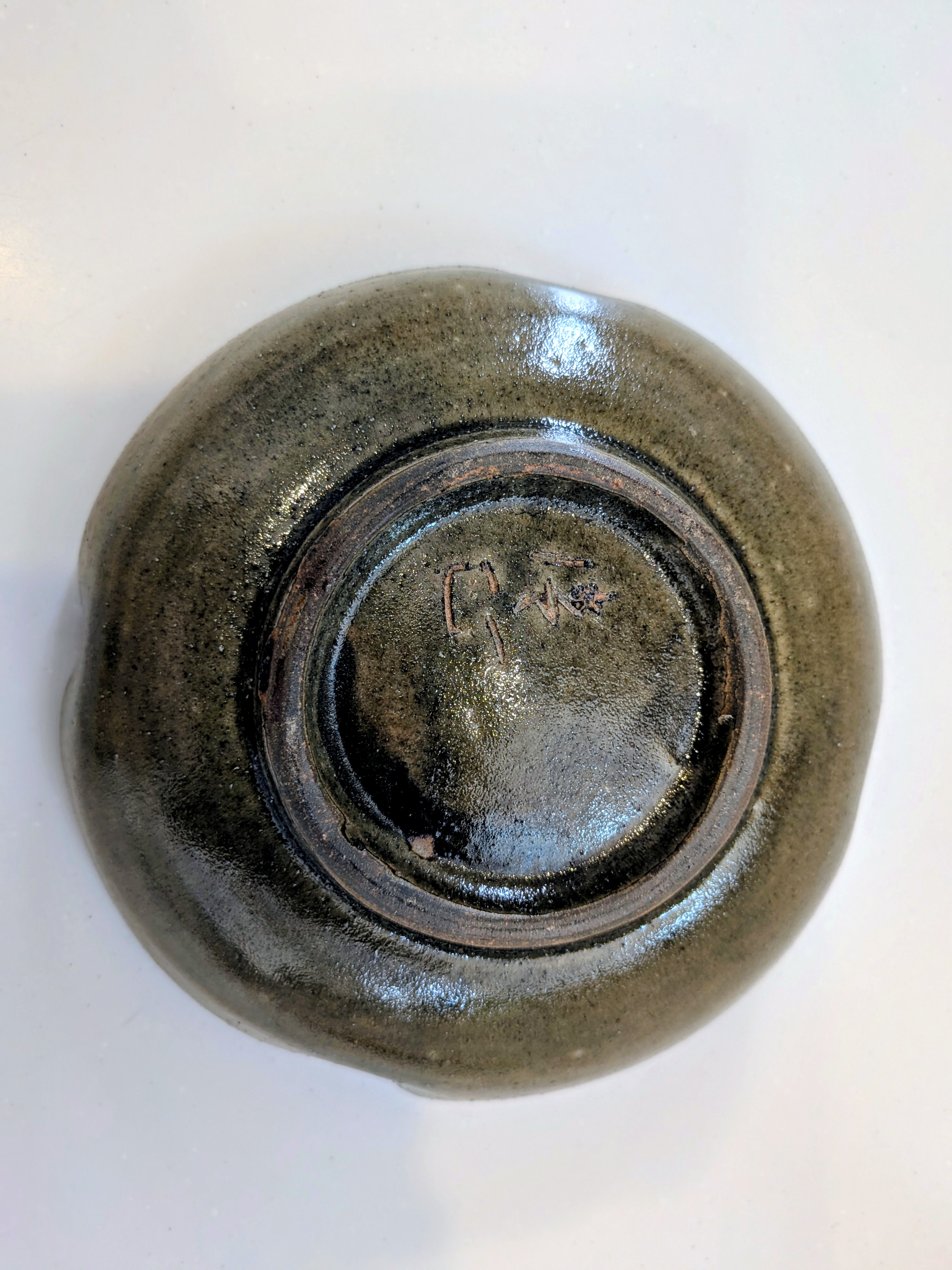
The underside bears Kobashigawa's hand-incised 「清」 (Kiyo) studio mark, providing an important identifying feature for collectors. The piece is presented by Xandre Store as an individual historical studio work rather than as a contemporary reproduction.
Master Kiyomasa Kobashigawa - Studio Heritage
Kiyomasa Kobashigawa (小橋川 清正) was associated with the historic Tsuboya pottery tradition of Naha, Okinawa, and operated through Kiyomasa Touki (清正陶器).
His work belongs to a period when Okinawan ceramic artists continued to reinterpret traditional Tsuboya forms, decorative motifs, and mineral-based surfaces for modern collectors and functional use.
Kobashigawa's association with the 2000 Kyushu-Okinawa G8 Summit is an important part of the documented history surrounding his career. His participation in work associated with the summit places his studio within a notable chapter of modern Okinawan ceramic history.
With the Kiyomasa Touki studio no longer operating, works carrying the artist's identifying mark represent a finite body of historical studio production.
The Fish Motif - Gyomon
The central fish decoration is one of the most recognizable visual traditions associated with Okinawan Yachimun. Fish imagery (Gyomon) is strongly associated with the maritime environment of Okinawa and is commonly interpreted in Okinawan decorative arts through themes of abundance, prosperity, vitality, and connection to the sea.
Rather than presenting the fish as a flat painted illustration, Kobashigawa integrates the motif into the ceramic surface through relief carving. This creates shadows and changes in texture as light moves across the dish. The result is a decoration that is simultaneously graphic, sculptural, and tactile.
The Mokkō Form
The dish's lobed outline gives it the characteristic appearance of a Mokkō-style foliate form.
The gently indented perimeter creates four principal lobes that visually frame the central medallion. This structure allows the fish motif to function almost like a miniature ceramic painting surrounded by a sculptural border.
For collectors, the combination of:
- Mokkō foliate form
- Gyomon fish decoration
- Akae-style red mineral coloration
- deep relief carving
- Kobashigawa's 「清」 signature
creates a particularly distinctive representation of the artist's decorative vocabulary.
Technical Craftsmanship
The creation of a small relief-carved dish requires considerable control despite its modest dimensions.
1. Forming the Body: The clay body must be shaped to establish an even thickness and stable profile before the decorative work begins.
2. Creating the Foliate Rim: The perimeter is carefully manipulated to create the symmetrical Mokkō-style lobing without compromising the dish's structural balance.
3. Relief Carving: The fish motif is carved into leather-hard clay using controlled hand pressure. On a small surface, even minor deviations can substantially affect the final composition.
4. Pigment & Glaze Application: Iron-rich red decoration and darker blue/cobalt-toned accents create the principal color contrast, while the surrounding darker glaze establishes depth around the central motif.
5. Firing: The completed work must withstand drying and kiln firing without significant warping, cracking, or distortion—particularly important for a shallow, lobed ceramic form.
Premium Collector Highlights
- Master Artist: Kiyomasa Kobashigawa (小橋川 清正)
- Historic Studio: Kiyomasa Touki / Tsuboya Kiln
- Traditional Form: Mokkō-zara (木瓜皿)
- Decorative Motif: Hand-carved Gyomon (魚紋)
- Technique: Relief carving (Senbori) with mineral-slip and glaze decoration
- Signature: Hand-incised 「清」 mark on the base
- Material: Okinawan ceramic clay with mineral-based decorative finishes
- Historical Period: Late 20th-century studio production
- Studio Status: Kiyomasa Touki is no longer operating
- Collector Character: Individual historical studio work with non-repeatable hand-carved decoration
Curator's Note
Small-format ceramics can reveal an artist's discipline particularly clearly. On this dish, the lobed Mokkō silhouette establishes a precise frame for the central fish motif, while the relief carving gives the decoration depth that changes with the surrounding light.
The contrast between the red central field, dark fish decoration, and subdued outer glaze gives the piece a distinctly Okinawan character. Combined with Kobashigawa's 「清」 studio mark and the now-closed Kiyomasa Touki lineage, the work offers collectors a compact and highly tactile example of modern Tsuboya ceramic craftsmanship.
Specifications
| Attribute | Details |
| Artist | Kiyomasa Kobashigawa (小橋川 清正) |
| Studio & Kiln | Kiyomasa Touki / Tsuboya Kiln (清正陶器・壺屋窯) |
| Origin | Tsuboya, Naha City, Okinawa, Japan |
| Category | Okinawan Tsuboya-yaki / Fine Art Collector Ceramic |
| Form | Foliate Small Dish / Mokkō-zara (魚紋木瓜皿) |
| Motif | Hand-carved Fish / Gyomon (魚紋) |
| Materials | Okinawan ceramic clay, mineral red slip, cobalt-toned decoration, glaze |
| Technique | Hand-forming, foliate rim shaping, relief carving and glazed decoration |
| Surface | Relief-carved central medallion with contrasting outer glaze |
| Markings | Hand-incised 「清」 studio mark on base |
| Era | Late 20th-century studio production |
| Studio Status | Kiyomasa Touki — historical studio no longer operating |
| Condition | Excellent vintage studio condition |
Care Instructions
- Handle gently by supporting the main body.
- Dust with a soft, dry microfiber cloth or soft brush.
- For occasional cleaning, use a slightly damp soft cloth and dry immediately.
- Avoid abrasive pads, wire brushes, and strong chemical cleaners.
- Do not place in a dishwasher or microwave.
- Avoid prolonged soaking.
- Keep away from sudden temperature changes and accidental impact.
Shipping & International Delivery
Domestic Japan: Insured shipping with protective double-box packaging.
International: Carefully protected international shipment is available. Destination-country customs duties, VAT, GST, import taxes, and customs clearance charges, where applicable, remain the responsibility of the recipient.
Because this is an individual historical ceramic work, Xandre Store will use protective packaging appropriate for its size, shape, and carved surface.
Xandre Store
Connecting global collectors with the craftsmanship, heritage, and stories behind Japan's finest regional studio traditions.
Previously viewed products
No recently viewed products.