

Description
Xandre Store Exclusive - A Historically Significant Tsuboya-Yaki Masterwork with Documented Artisan Lineage
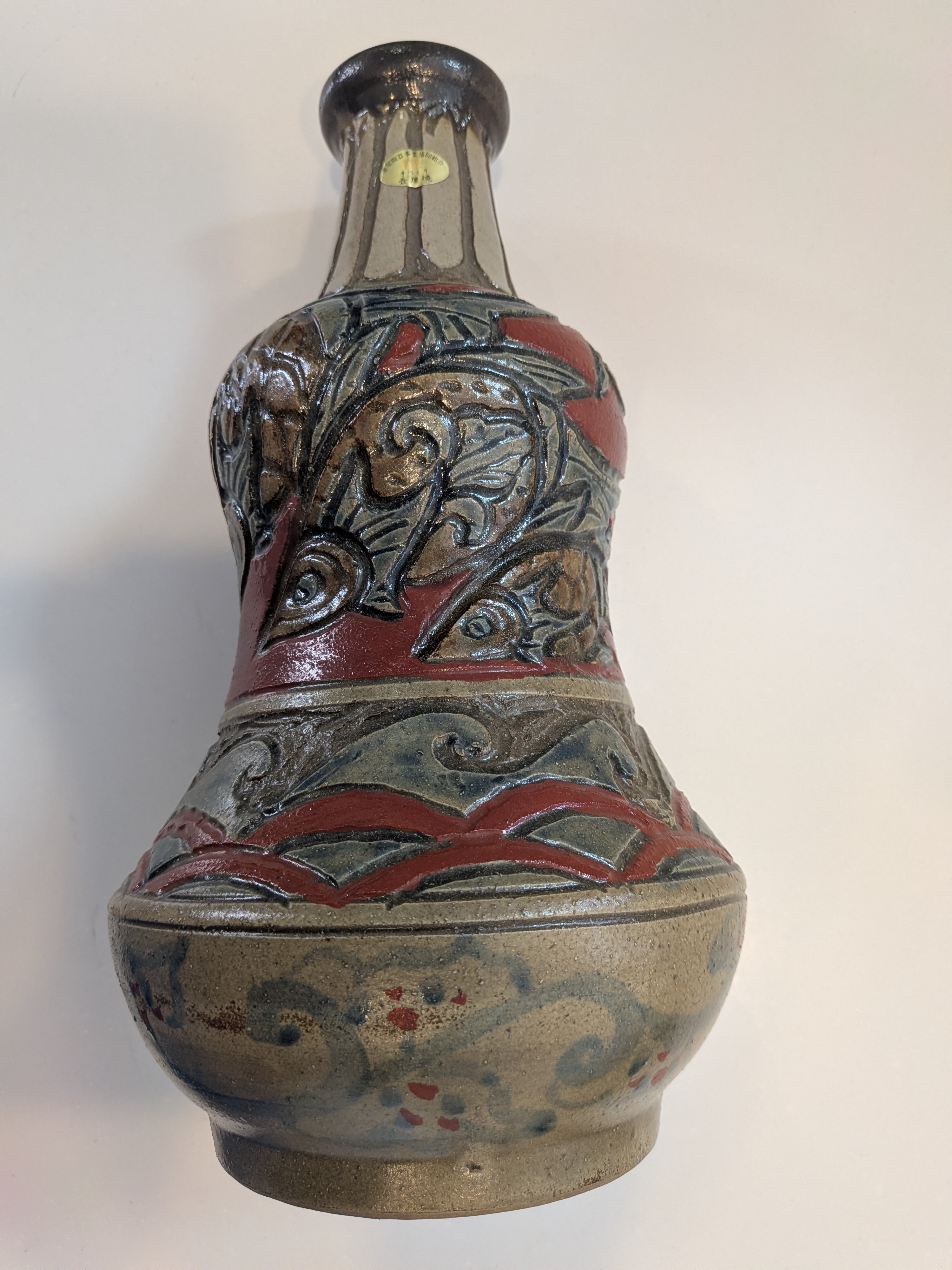
This exceptional large-format fish-motif bottle vase (Gyomon Tsubo / 魚紋壺) by Okinawan master potter Kiyomasa Kobashigawa (小橋川 清正) represents a distinctive expression of traditional Tsuboya-yaki (壺屋焼) ceramic craftsmanship from Naha, Okinawa.
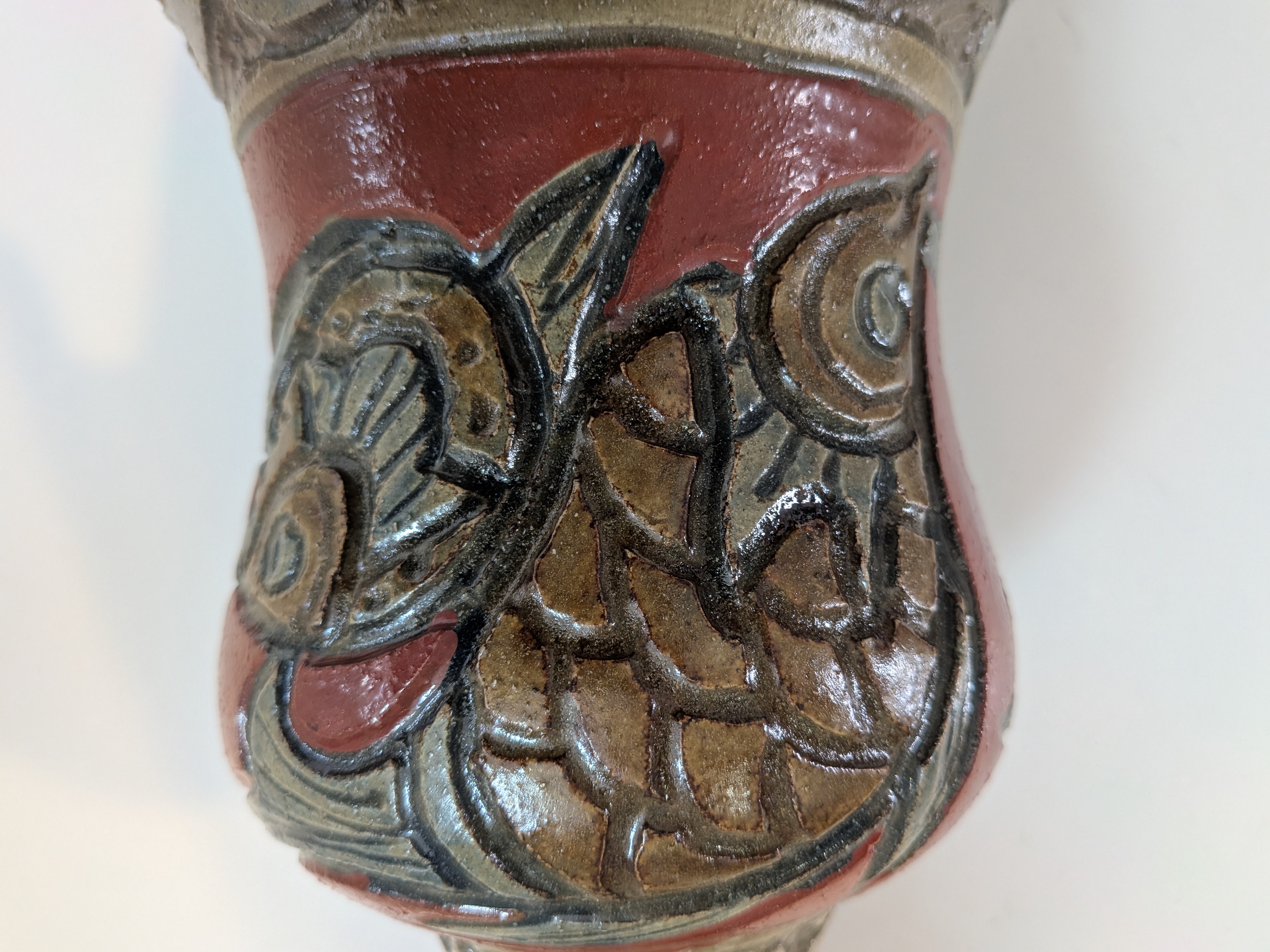
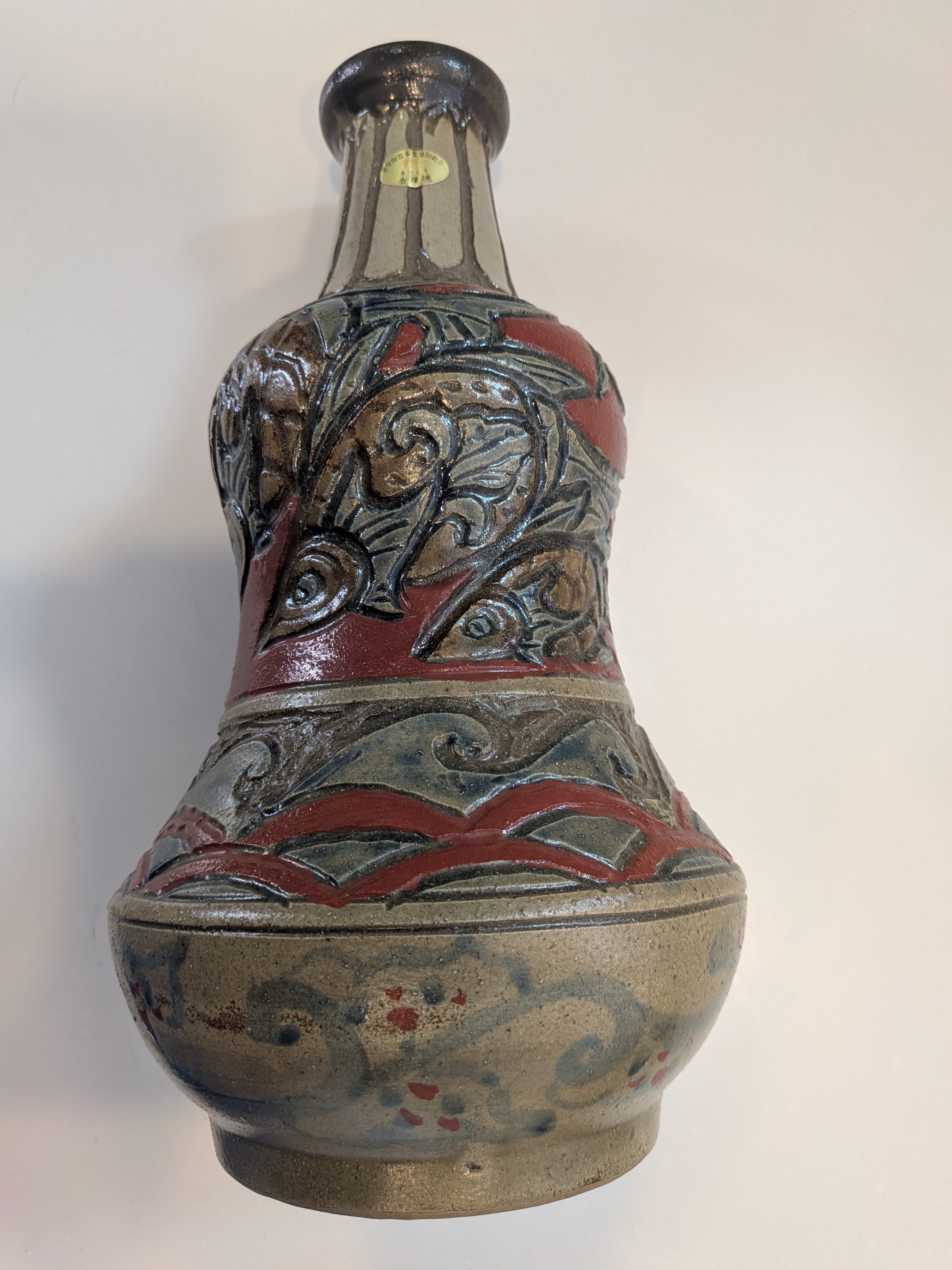
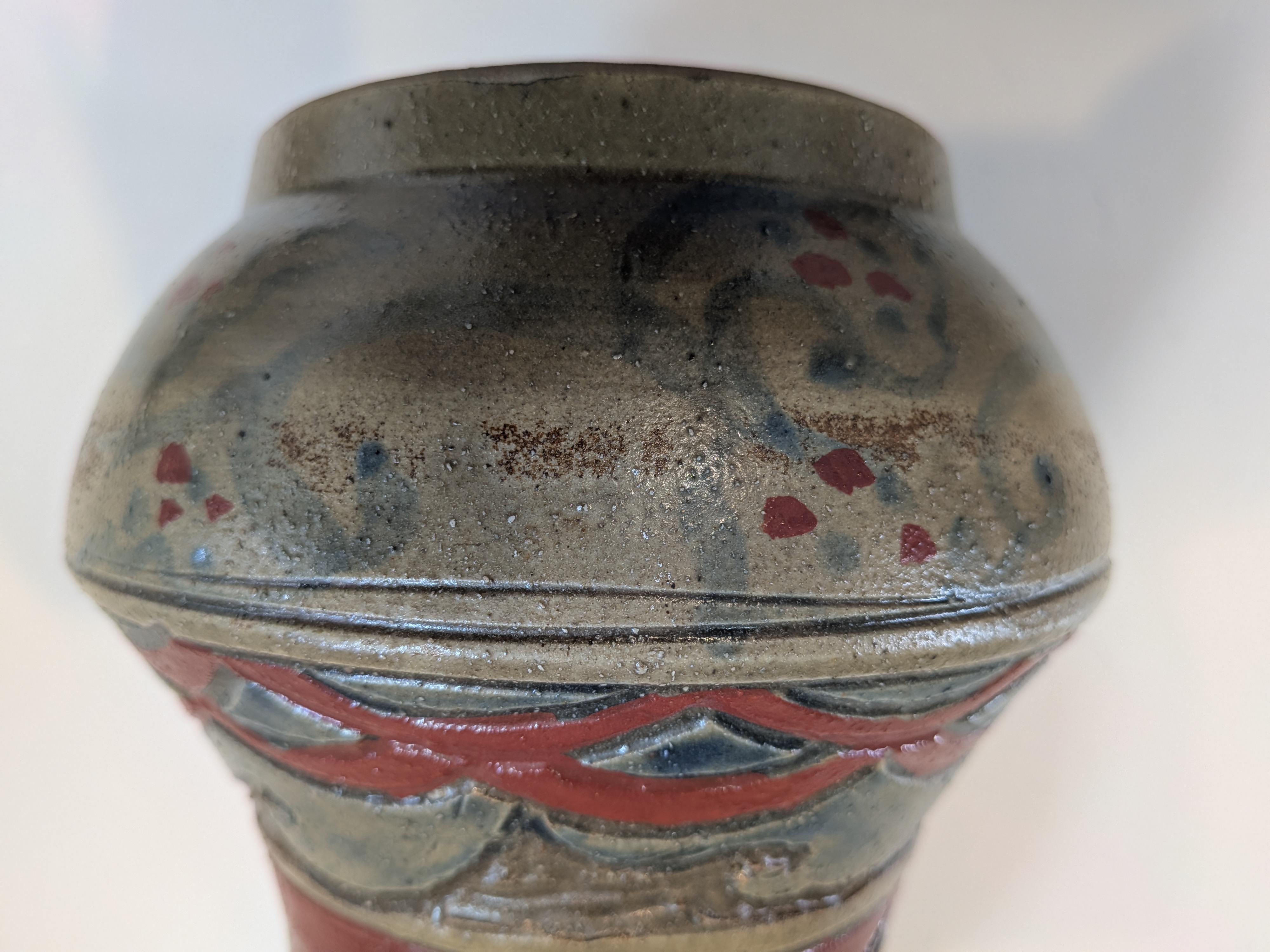
The vessel combines a substantial bottle-vase silhouette with deeply carved fish and wave motifs, rich red mineral coloration, cobalt-blue accents, and darker mineral glaze tones. The relief carving creates pronounced changes in depth across the body, allowing the surrounding glaze and slip colors to emphasize the movement of the fish and ocean imagery.
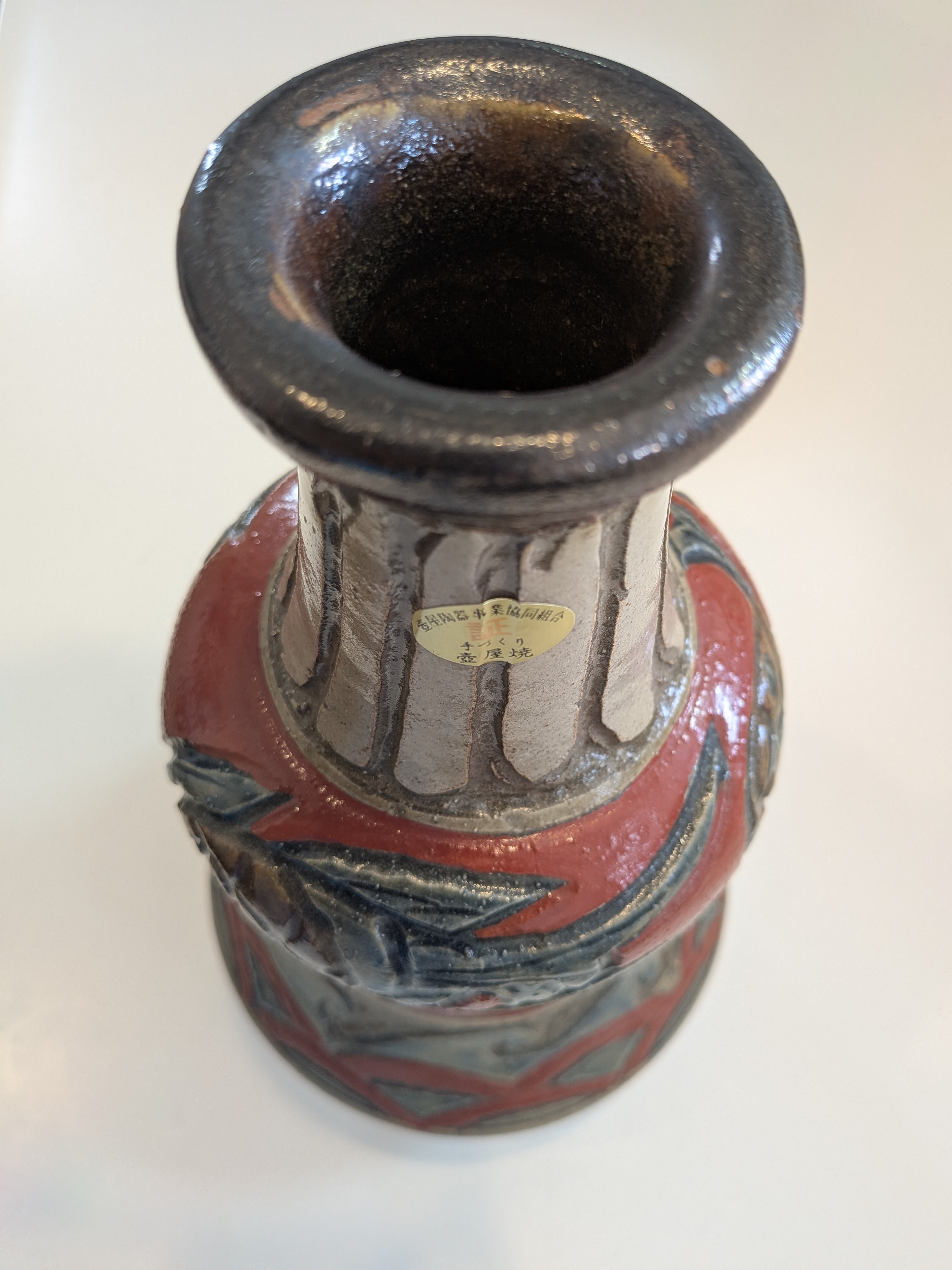
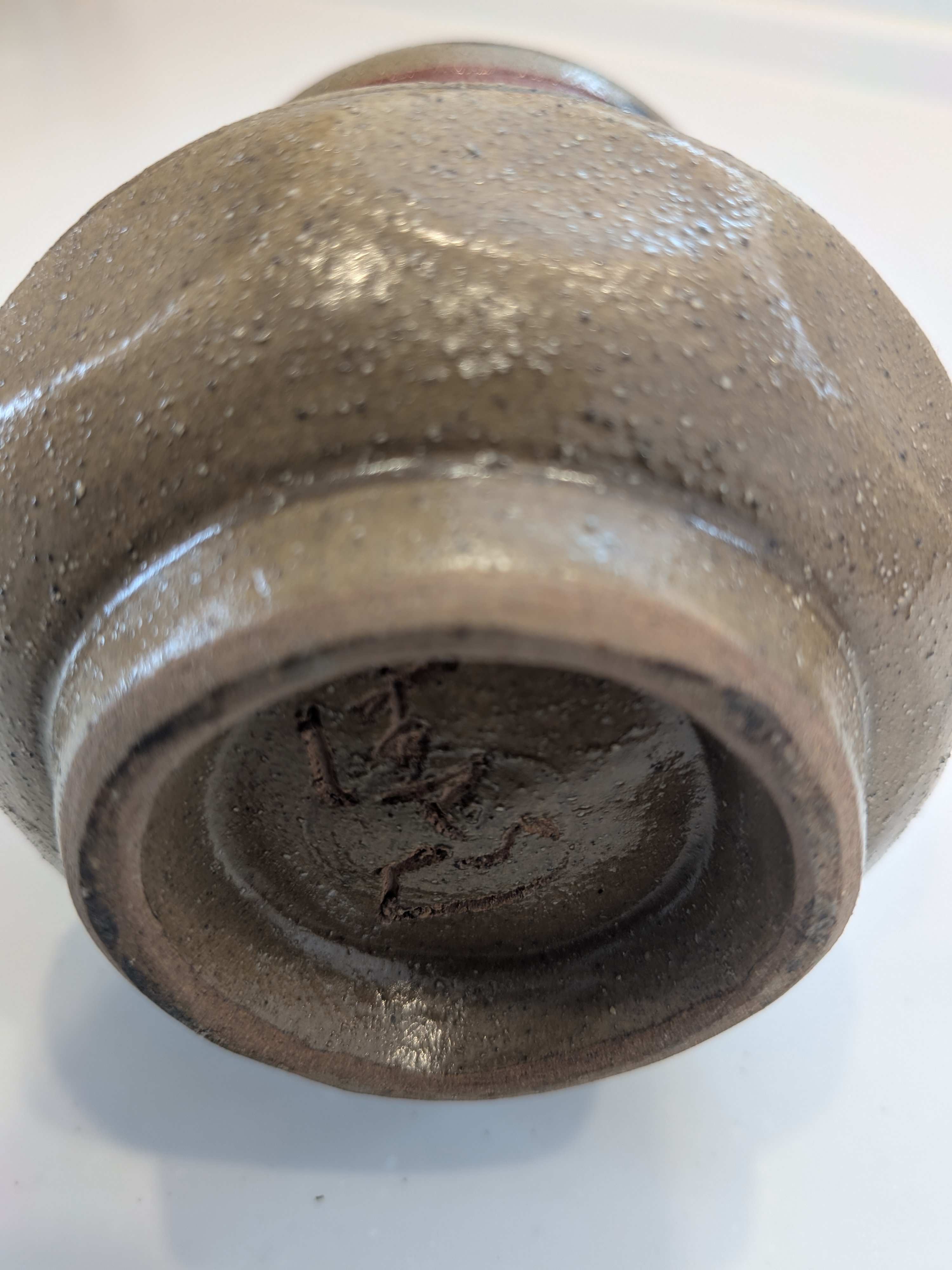
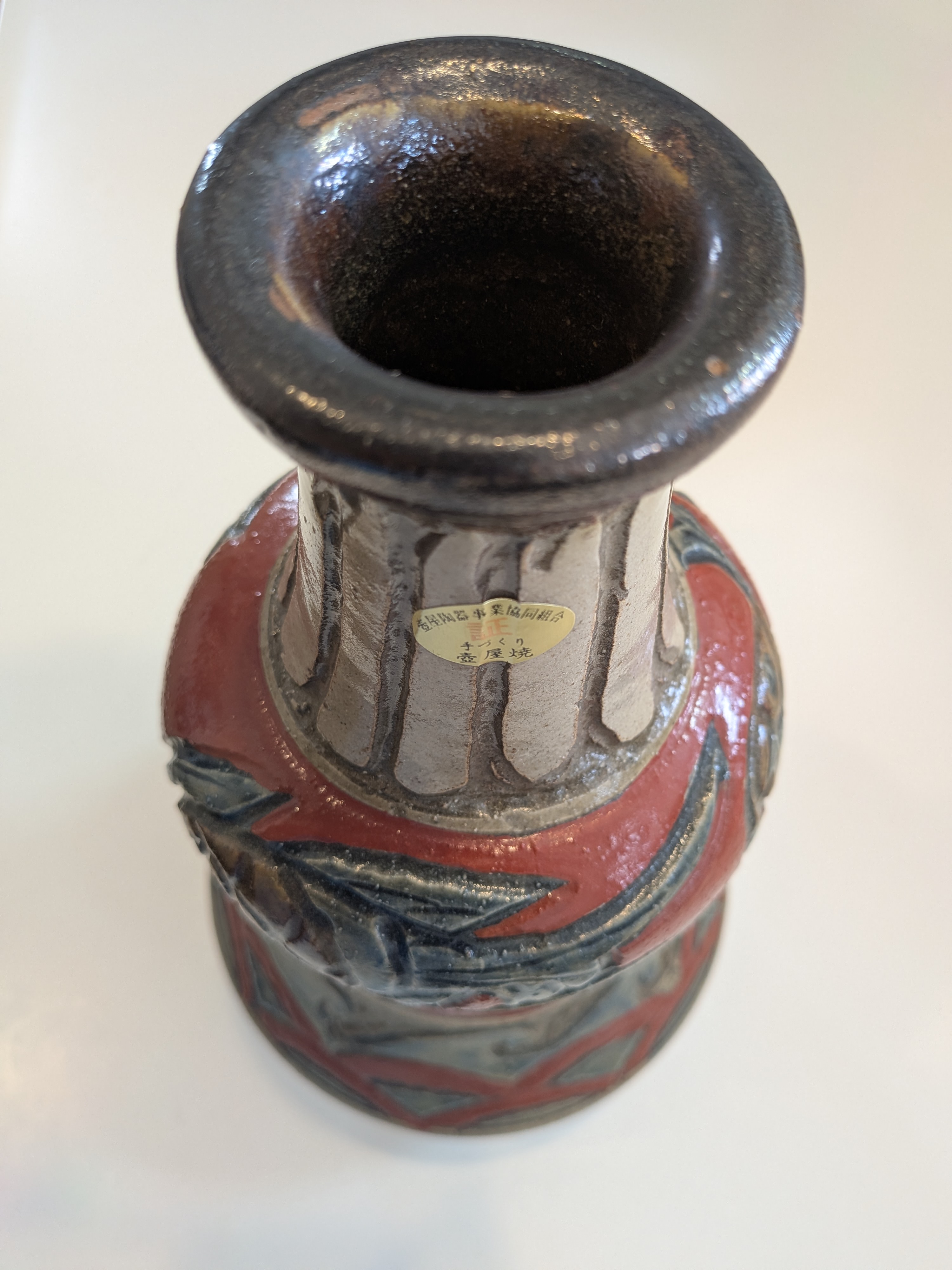
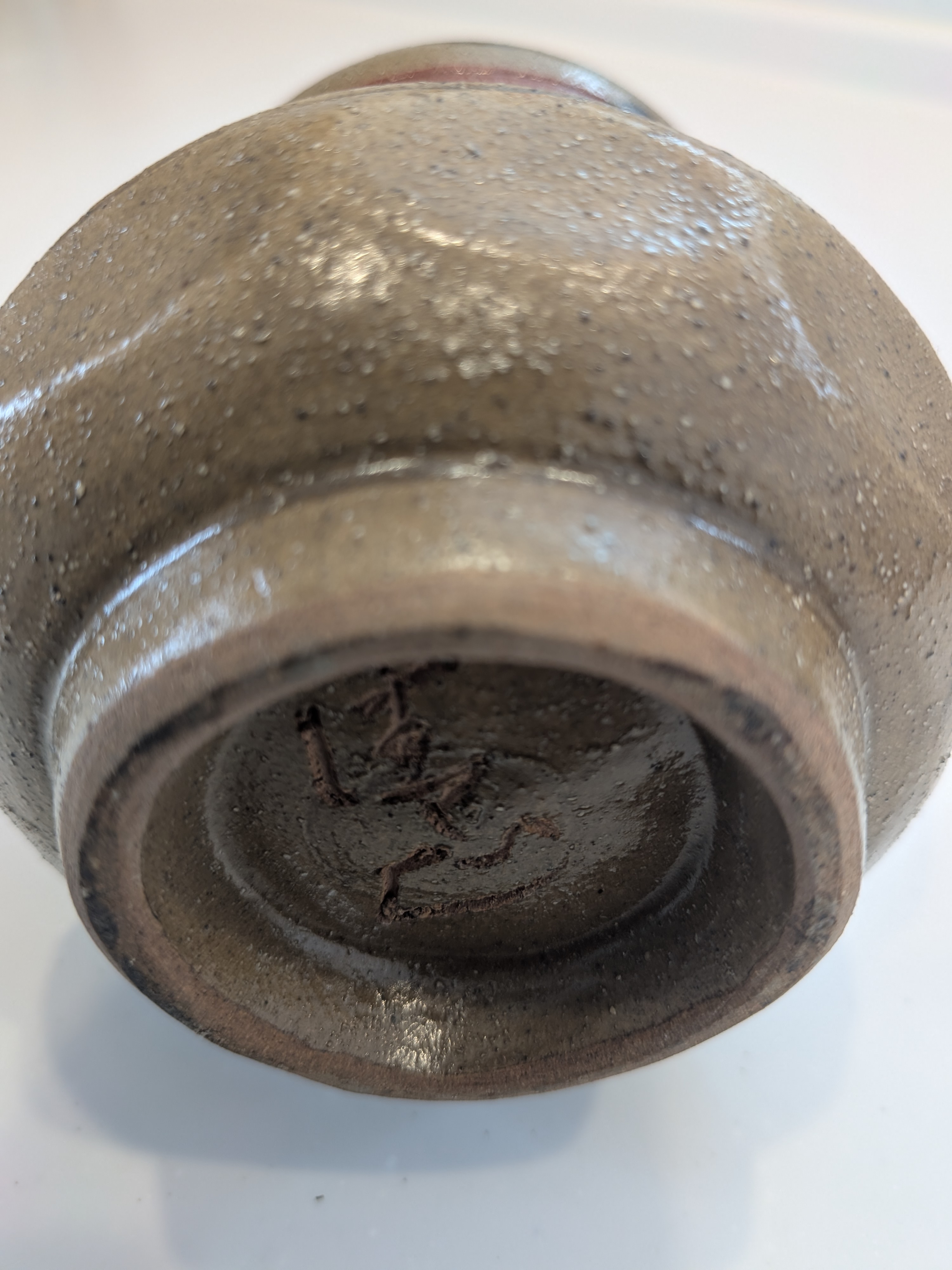
The piece is particularly significant because it bears both Kobashigawa's 「清」 studio mark and the Tsuboya Pottery Cooperative authentication marking, providing physical identifiers connecting the vessel to the Kiyomasa Touki / Tsuboya ceramic tradition.
The studio associated with Kobashigawa has since ceased operations, making surviving works from this period finite examples of his independent studio production.
Kiyomasa Kobashigawa - Tsuboya Master Potter
Kiyomasa Kobashigawa (小橋川 清正) was part of the long-established ceramic tradition of Okinawa's historic Tsuboya district, one of the most important centers of Okinawan pottery.
His practice belongs to the lineage of Okinawan Yachimun in which functional ceramic forms are elevated through distinctive hand-carved decoration, mineral-rich glazes, and the visual language of Okinawan life.
Kobashigawa is also associated with the 2000 Kyushu-Okinawa G8 Summit held in Okinawa. His participation in work associated with the summit forms an important part of the historical context surrounding his career and the recognition of Okinawan craftsmanship during this period. For this reason, works bearing his individual studio mark and corresponding Tsuboya authentication markings provide collectors with a tangible connection to a specific period of modern Okinawan ceramic history.
Signature Fish Motif - 魚紋
The fish motif (Gyomon / 魚紋) occupies an important position within Okinawan ceramic decoration. Fish naturally evoke the surrounding Ryukyu sea and are commonly associated with themes such as abundance, prosperity, vitality, and the relationship between Okinawan life and the ocean.
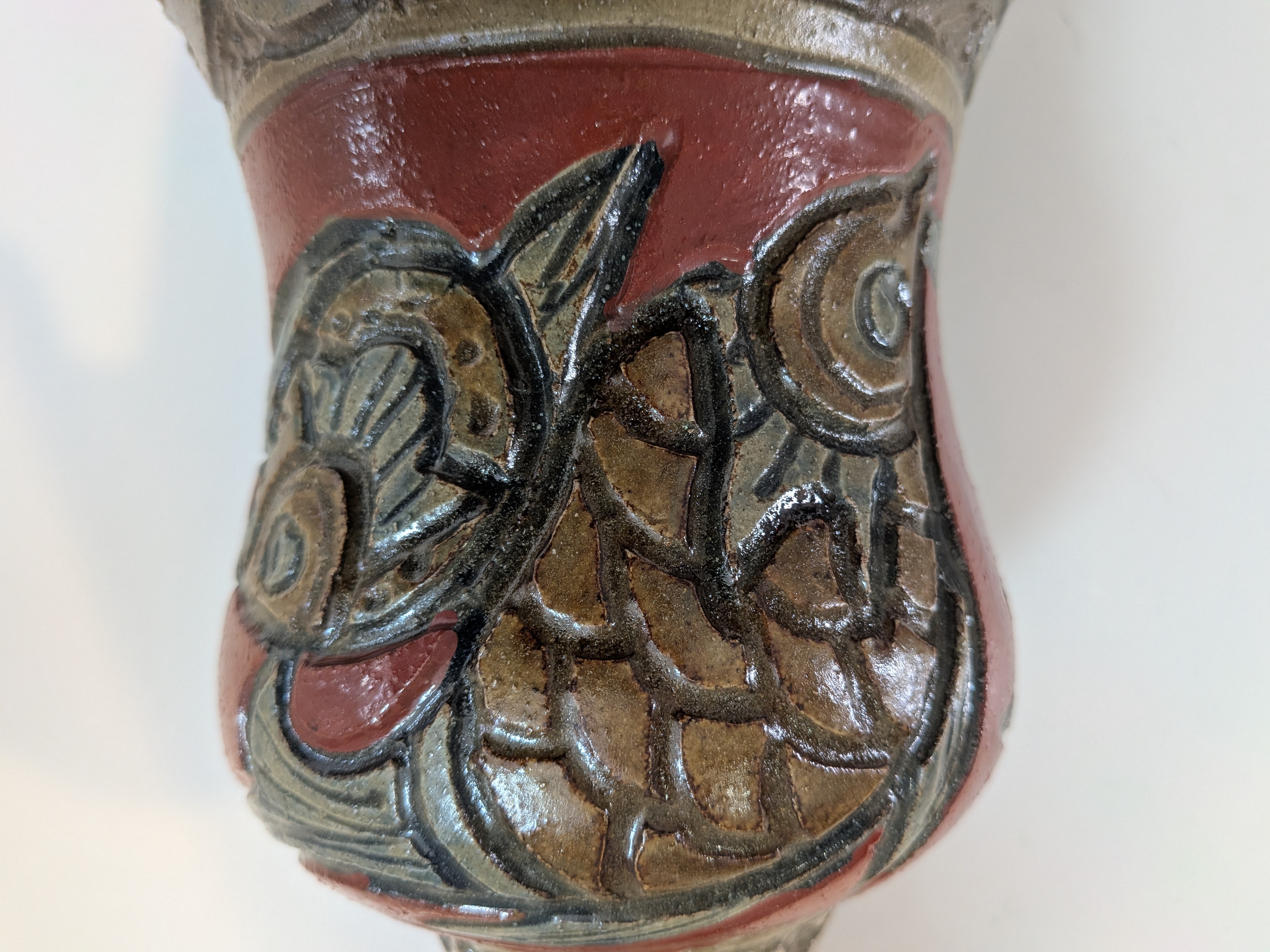
On this vessel, the fish are not merely painted onto the surface. Instead, the imagery is integrated into the ceramic body through hand-carved relief work, giving the composition physical depth.
The carved waves and fish create an almost continuous movement around the vessel, producing different visual impressions depending on the direction of light.
Relief Carving & Glaze Character
The technical character of this work is particularly evident in its surface treatment.
Deep Hand-Carved Relief: The fish and surrounding wave forms are carved directly into the ceramic body, producing recessed and raised areas that remain visually distinct beneath the glaze.
Red-Slip Foundation: The warm red-orange ceramic coloration provides the visual foundation for the composition and creates a strong contrast with the darker glaze areas.
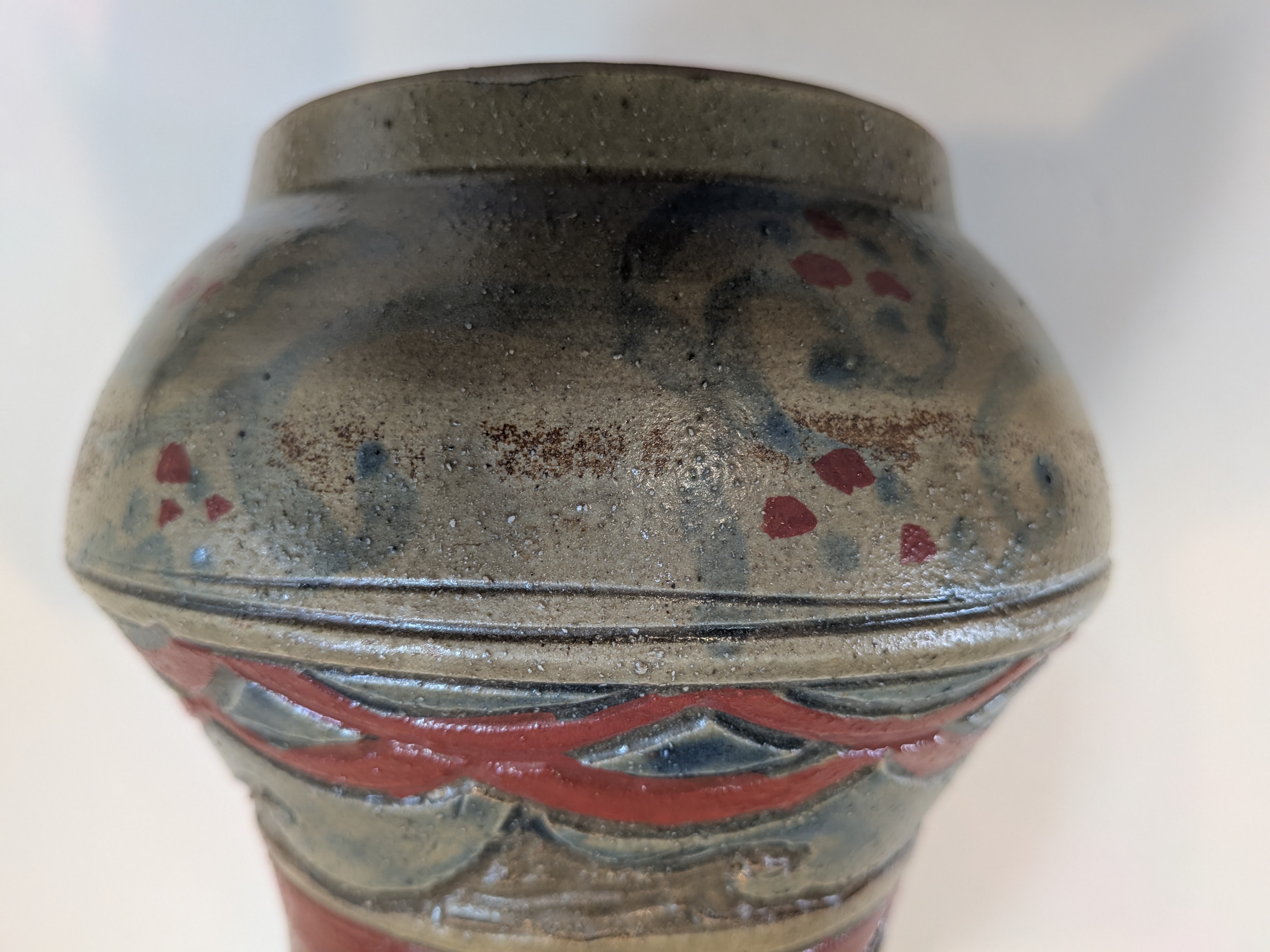
Cobalt & Mineral Accents: Blue and darker mineral tones emphasize selected portions of the fish and wave decoration, creating additional depth without overwhelming the underlying clay body.
Individual Firing Character: As with traditionally produced Okinawan ceramics, variations in glaze pooling, coloration, surface texture, and firing response contribute to the individual character of the vessel.
Physical Authentication & Provenance Features
One of the most important characteristics of this particular example is the presence of identifiable studio markings.
- Kobashigawa studio mark: Hand-incised 「清」 (Kiyo) associated with Kiyomasa Kobashigawa.
- Tsuboya Pottery Cooperative marking: Present on the vessel as an additional institutional/studio authentication identifier.
- Original ceramic construction: The markings are incorporated into the physical work rather than being solely dependent upon later documentation.
- Studio lineage: Associated with Kiyomasa Touki / Tsuboya-yaki production in Naha, Okinawa.
Together, these features provide substantially more provenance information than an unmarked vintage Okinawan ceramic.
Why This Piece Is Collectible
The importance of this vessel is not based simply on its decorative appearance.
It combines several attributes relevant to collectors of Japanese studio ceramics:
Named artist → identifiable studio → traditional Tsuboya form → hand-carved fish motif → physical maker's mark → Tsuboya authentication marking → established Okinawan ceramic lineage → finite historical production.
The closure of the associated studio also means that new works from this specific studio production period cannot simply be commissioned from the same workshop today.
This makes the piece a finite historical studio work, rather than a currently reproducible commercial product.
Premium Highlights
- Master Potter: Kiyomasa Kobashigawa (小橋川 清正)
- Studio: Kiyomasa Touki / Tsuboya Kiln (清正陶器・壺屋窯)
- Historic Origin: Tsuboya district, Naha, Okinawa
- Form: Large bottle vase / Tsubo / Tokkuri (魚紋壺)
- Signature Decoration: Hand-carved fish and wave motif (Gyomon / 魚紋)
- Technique: Deep hand-carved ceramic relief with mineral slip and glaze decoration
- Coloration: Red-orange clay, iron-red, cobalt blue, manganese/dark mineral tones
- Authentication: Kobashigawa 「清」 studio mark and Tsuboya Pottery Cooperative marking
- Historical Context: Kobashigawa's career is associated with the preservation and presentation of traditional Okinawan ceramic craftsmanship during the modern era
- Studio Status: Kiyomasa Touki is no longer operating, making surviving works from its production period finite
- Collector Profile: Particularly suited to collectors of Okinawan Yachimun, Tsuboya-yaki, Japanese studio ceramics, and regional craft history
Curator's Note
The strength of this work lies in its combination of sculptural form, carved narrative, and identifiable Okinawan provenance. The fish appear to move around the vessel rather than simply decorate it, while the deep relief creates a changing pattern of shadow across the ceramic surface. The contrast between the red body, blue accents, and darker mineral tones gives the vessel considerable visual weight.
For a collector, the physical 「清」 mark and Tsuboya Cooperative marking are especially important. They transform the object from an anonymous vintage ceramic into a work with identifiable maker and studio context. The result is a substantial example of Okinawan Yachimun that can be appreciated simultaneously as a functional historical vessel, a sculptural ceramic, and a document of modern Tsuboya craftsmanship.
Specifications
| Attribute | Details |
| Artist | Kiyomasa Kobashigawa (小橋川 清正) |
| Studio / Kiln | Kiyomasa Touki / Tsuboya Kiln (清正陶器・壺屋窯) |
| Origin | Tsuboya District, Naha City, Okinawa Prefecture, Japan |
| Category | Okinawan Yachimun / Tsuboya-yaki / Fine Art Ceramic |
| Form | Fish-Motif Bottle Vase (Gyomon Tsubo / 魚紋壺) |
| Motif | Fish and ocean-wave relief |
| Technique | Hand-thrown ceramic construction with hand-carved relief and mineral glaze decoration |
| Materials | Okinawan ceramic clay, mineral pigments and glaze |
| Color Palette | Red-orange, iron red, cobalt blue, manganese and dark mineral tones |
| Maker's Mark | Hand-incised 「清」 mark |
| Additional Marking | Tsuboya Pottery Cooperative authentication marking |
| Era | Vintage studio production; exact dating should follow available studio/provenance documentation |
| Studio Status | Kiyomasa Touki no longer operating |
| Quantity | One individual historical studio vessel |
Condition
The individual piece should be evaluated from the supplied photographs and physical inspection before publication of an absolute condition designation.
For the online listing, a safer premium formulation is:
Condition: Excellent vintage studio condition, with the natural surface characteristics expected of an individually fired Okinawan ceramic. Please review all photographs carefully for the exact condition of this example. Any chips, restoration, hairlines, firing cracks, glaze irregularities, or other condition observations should be specifically disclosed if present.
Care Instructions
- Display on a stable, level surface or secure pedestal.
- Dust gently with a soft, dry microfiber cloth or soft brush.
- Avoid abrasive cleaning materials.
- Do not use harsh chemical cleaners.
- Avoid prolonged soaking or submersion.
- Keep away from sudden impacts and extreme temperature changes.
- When moving the vessel, support the main body with both hands rather than lifting from the neck or decorative areas.
Shipping & International Delivery
Japan: Carefully packed using protective materials appropriate for collectible ceramics and shipped through an insured carrier where available.
International: Secure international shipping can be arranged. Destination-country customs duties, VAT/GST, import taxes, brokerage charges, and customs-clearance fees may apply and remain the responsibility of the recipient.
For a large historical ceramic of this nature, Xandre Store recommends professional double-box protective packaging with reinforced internal cushioning.
Xandre Store
Connecting global collectors with the craftsmanship, heritage, and stories behind Japan's finest regional studio traditions.
Description
Xandre Store Exclusive - A Historically Significant Tsuboya-Yaki Masterwork with Documented Artisan Lineage
This exceptional large-format fish-motif bottle vase (Gyomon Tsubo / 魚紋壺) by Okinawan master potter Kiyomasa Kobashigawa (小橋川 清正) represents a distinctive expression of traditional Tsuboya-yaki (壺屋焼) ceramic craftsmanship from Naha, Okinawa.
The vessel combines a substantial bottle-vase silhouette with deeply carved fish and wave motifs, rich red mineral coloration, cobalt-blue accents, and darker mineral glaze tones. The relief carving creates pronounced changes in depth across the body, allowing the surrounding glaze and slip colors to emphasize the movement of the fish and ocean imagery.
The piece is particularly significant because it bears both Kobashigawa's 「清」 studio mark and the Tsuboya Pottery Cooperative authentication marking, providing physical identifiers connecting the vessel to the Kiyomasa Touki / Tsuboya ceramic tradition.
The studio associated with Kobashigawa has since ceased operations, making surviving works from this period finite examples of his independent studio production.
Kiyomasa Kobashigawa - Tsuboya Master Potter
Kiyomasa Kobashigawa (小橋川 清正) was part of the long-established ceramic tradition of Okinawa's historic Tsuboya district, one of the most important centers of Okinawan pottery.
His practice belongs to the lineage of Okinawan Yachimun in which functional ceramic forms are elevated through distinctive hand-carved decoration, mineral-rich glazes, and the visual language of Okinawan life.
Kobashigawa is also associated with the 2000 Kyushu-Okinawa G8 Summit held in Okinawa. His participation in work associated with the summit forms an important part of the historical context surrounding his career and the recognition of Okinawan craftsmanship during this period. For this reason, works bearing his individual studio mark and corresponding Tsuboya authentication markings provide collectors with a tangible connection to a specific period of modern Okinawan ceramic history.
Signature Fish Motif - 魚紋
The fish motif (Gyomon / 魚紋) occupies an important position within Okinawan ceramic decoration. Fish naturally evoke the surrounding Ryukyu sea and are commonly associated with themes such as abundance, prosperity, vitality, and the relationship between Okinawan life and the ocean.
On this vessel, the fish are not merely painted onto the surface. Instead, the imagery is integrated into the ceramic body through hand-carved relief work, giving the composition physical depth.
The carved waves and fish create an almost continuous movement around the vessel, producing different visual impressions depending on the direction of light.
Relief Carving & Glaze Character
The technical character of this work is particularly evident in its surface treatment.
Deep Hand-Carved Relief: The fish and surrounding wave forms are carved directly into the ceramic body, producing recessed and raised areas that remain visually distinct beneath the glaze.
Red-Slip Foundation: The warm red-orange ceramic coloration provides the visual foundation for the composition and creates a strong contrast with the darker glaze areas.
Cobalt & Mineral Accents: Blue and darker mineral tones emphasize selected portions of the fish and wave decoration, creating additional depth without overwhelming the underlying clay body.
Individual Firing Character: As with traditionally produced Okinawan ceramics, variations in glaze pooling, coloration, surface texture, and firing response contribute to the individual character of the vessel.
Physical Authentication & Provenance Features
One of the most important characteristics of this particular example is the presence of identifiable studio markings.
- Kobashigawa studio mark: Hand-incised 「清」 (Kiyo) associated with Kiyomasa Kobashigawa.
- Tsuboya Pottery Cooperative marking: Present on the vessel as an additional institutional/studio authentication identifier.
- Original ceramic construction: The markings are incorporated into the physical work rather than being solely dependent upon later documentation.
- Studio lineage: Associated with Kiyomasa Touki / Tsuboya-yaki production in Naha, Okinawa.
Together, these features provide substantially more provenance information than an unmarked vintage Okinawan ceramic.
Why This Piece Is Collectible
The importance of this vessel is not based simply on its decorative appearance.
It combines several attributes relevant to collectors of Japanese studio ceramics:
Named artist → identifiable studio → traditional Tsuboya form → hand-carved fish motif → physical maker's mark → Tsuboya authentication marking → established Okinawan ceramic lineage → finite historical production.
The closure of the associated studio also means that new works from this specific studio production period cannot simply be commissioned from the same workshop today.
This makes the piece a finite historical studio work, rather than a currently reproducible commercial product.
Premium Highlights
- Master Potter: Kiyomasa Kobashigawa (小橋川 清正)
- Studio: Kiyomasa Touki / Tsuboya Kiln (清正陶器・壺屋窯)
- Historic Origin: Tsuboya district, Naha, Okinawa
- Form: Large bottle vase / Tsubo / Tokkuri (魚紋壺)
- Signature Decoration: Hand-carved fish and wave motif (Gyomon / 魚紋)
- Technique: Deep hand-carved ceramic relief with mineral slip and glaze decoration
- Coloration: Red-orange clay, iron-red, cobalt blue, manganese/dark mineral tones
- Authentication: Kobashigawa 「清」 studio mark and Tsuboya Pottery Cooperative marking
- Historical Context: Kobashigawa's career is associated with the preservation and presentation of traditional Okinawan ceramic craftsmanship during the modern era
- Studio Status: Kiyomasa Touki is no longer operating, making surviving works from its production period finite
- Collector Profile: Particularly suited to collectors of Okinawan Yachimun, Tsuboya-yaki, Japanese studio ceramics, and regional craft history
Curator's Note
The strength of this work lies in its combination of sculptural form, carved narrative, and identifiable Okinawan provenance. The fish appear to move around the vessel rather than simply decorate it, while the deep relief creates a changing pattern of shadow across the ceramic surface. The contrast between the red body, blue accents, and darker mineral tones gives the vessel considerable visual weight.
For a collector, the physical 「清」 mark and Tsuboya Cooperative marking are especially important. They transform the object from an anonymous vintage ceramic into a work with identifiable maker and studio context. The result is a substantial example of Okinawan Yachimun that can be appreciated simultaneously as a functional historical vessel, a sculptural ceramic, and a document of modern Tsuboya craftsmanship.
Specifications
| Attribute | Details |
| Artist | Kiyomasa Kobashigawa (小橋川 清正) |
| Studio / Kiln | Kiyomasa Touki / Tsuboya Kiln (清正陶器・壺屋窯) |
| Origin | Tsuboya District, Naha City, Okinawa Prefecture, Japan |
| Category | Okinawan Yachimun / Tsuboya-yaki / Fine Art Ceramic |
| Form | Fish-Motif Bottle Vase (Gyomon Tsubo / 魚紋壺) |
| Motif | Fish and ocean-wave relief |
| Technique | Hand-thrown ceramic construction with hand-carved relief and mineral glaze decoration |
| Materials | Okinawan ceramic clay, mineral pigments and glaze |
| Color Palette | Red-orange, iron red, cobalt blue, manganese and dark mineral tones |
| Maker's Mark | Hand-incised 「清」 mark |
| Additional Marking | Tsuboya Pottery Cooperative authentication marking |
| Era | Vintage studio production; exact dating should follow available studio/provenance documentation |
| Studio Status | Kiyomasa Touki no longer operating |
| Quantity | One individual historical studio vessel |
Condition
The individual piece should be evaluated from the supplied photographs and physical inspection before publication of an absolute condition designation.
For the online listing, a safer premium formulation is:
Condition: Excellent vintage studio condition, with the natural surface characteristics expected of an individually fired Okinawan ceramic. Please review all photographs carefully for the exact condition of this example. Any chips, restoration, hairlines, firing cracks, glaze irregularities, or other condition observations should be specifically disclosed if present.
Care Instructions
- Display on a stable, level surface or secure pedestal.
- Dust gently with a soft, dry microfiber cloth or soft brush.
- Avoid abrasive cleaning materials.
- Do not use harsh chemical cleaners.
- Avoid prolonged soaking or submersion.
- Keep away from sudden impacts and extreme temperature changes.
- When moving the vessel, support the main body with both hands rather than lifting from the neck or decorative areas.
Shipping & International Delivery
Japan: Carefully packed using protective materials appropriate for collectible ceramics and shipped through an insured carrier where available.
International: Secure international shipping can be arranged. Destination-country customs duties, VAT/GST, import taxes, brokerage charges, and customs-clearance fees may apply and remain the responsibility of the recipient.
For a large historical ceramic of this nature, Xandre Store recommends professional double-box protective packaging with reinforced internal cushioning.
Xandre Store
Connecting global collectors with the craftsmanship, heritage, and stories behind Japan's finest regional studio traditions.
Previously viewed products
No recently viewed products.