

Description
Xandre Store Exclusive - A Sculptural Okinawan Glass Table Accent by Takumi Matsumuro
- Artist: Takumi Matsumuro (松室 巧)
- Studio: Ryukyu Glass Takumi Kōbō (琉球ガラス たくみ工房)
- Acquisition Location: Onna Village, Okinawa Prefecture, Japan
- Category: Okinawan Hand-Blown Glass | Fine Art Chopstick Rest | Luxury Tableware Accent
- Craft Tradition: 宙吹ガラス (Chūfuki - free-form mouth-blown glass)
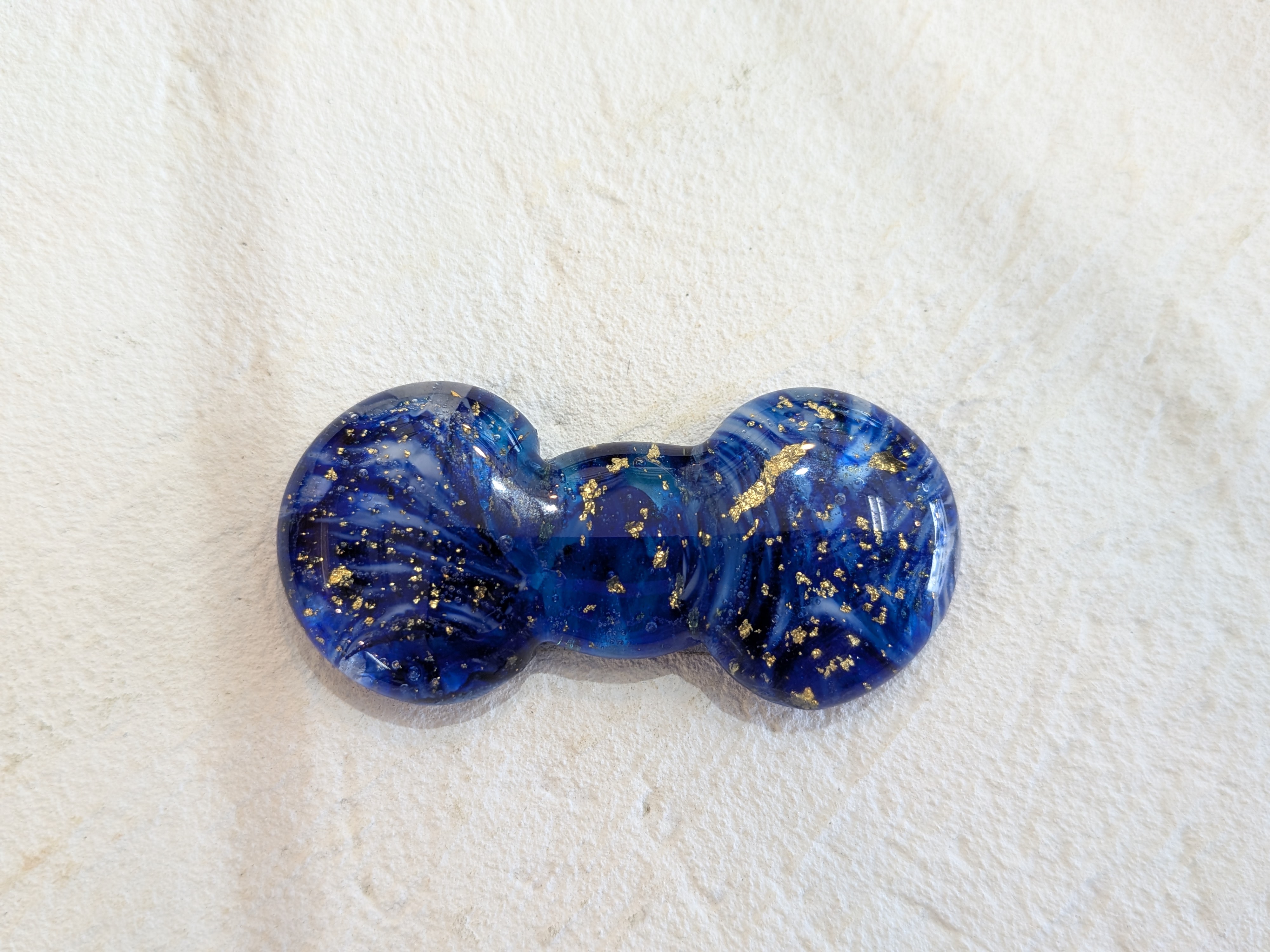
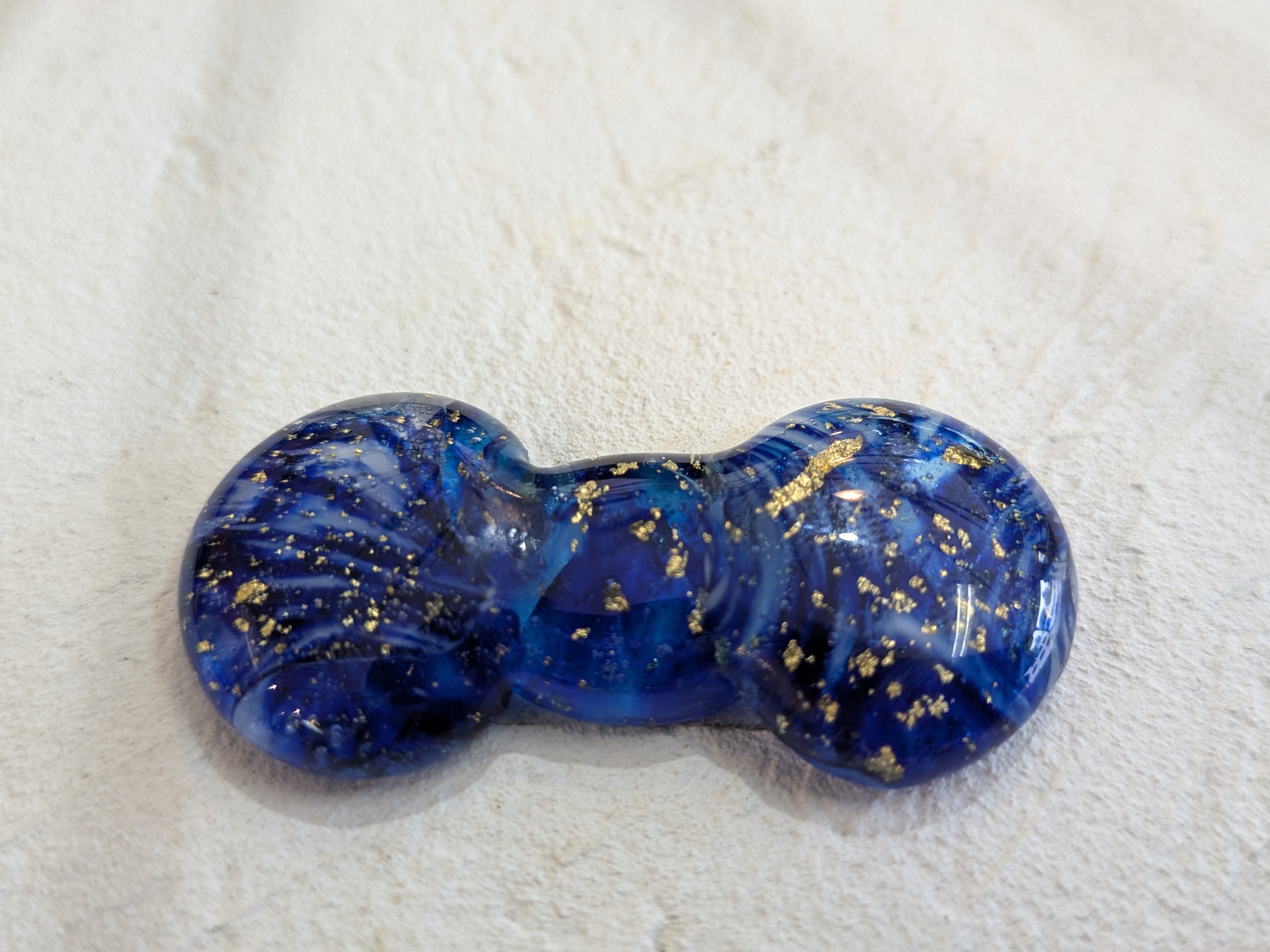
This Earth Edition hand-blown Ryukyu glass chopstick and cutlery rest by Takumi Matsumuro (松室 巧) brings the visual character of Okinawa's coastal waters to the dining table in a compact sculptural form. The distinctive figure-eight or peanut-shaped silhouette creates two rounded lobes connected by a gently shaped central bridge, providing a stable resting point for chopsticks and selected pieces of fine cutlery.
Deep cobalt blue, lapis and optic-white glass move organically through the body, while metallic-gold elements provide luminous accents within the composition. Fine internal bubbles add further depth, catching and scattering light as the piece is viewed from different angles.
Despite its small scale, the rest has a substantial visual presence. Its smooth hand-formed surface, concentrated color movement and gold detailing allow it to function as both a practical table accessory and a small-format example of contemporary Okinawan studio glass.
Takumi Matsumuro & the Takumi Kōbō Tradition
Takumi Matsumuro (松室 巧) is presented with this work as the named artisan associated with the piece and Takumi Kōbō. The work belongs to the Okinawan tradition of Chūfuki (宙吹き) glassmaking, in which molten glass is shaped through blowing, rotation, heating and direct hand manipulation. This free-form approach gives individually made pieces their own variations in color distribution, contours, bubbles and internal movement. For the final collector listing, any specific professional designation, award or certification attributed directly to Matsumuro should be supported by the artist or studio documentation accompanying the work.
Gold, Ocean & Form
The design brings together three principal visual elements:
Cobalt & Lapis Ocean Currents: Deep blue glass creates the dominant visual field, with flowing variations that suggest underwater movement.
Luminous Gold Elements: Gold-leaf details introduce warm metallic highlights against the cooler blue palette.
Sculptural Bridge Form: The paired-lobe construction gives the piece its distinctive silhouette while creating a practical central resting area for chopsticks or appropriate cutlery.
The result is a small object in which function, color and sculptural form are deliberately integrated.
Chūfuki - Free-Form Hand-Blown Glass
Chūfuki (宙吹き) is a traditional free-form mouth-blown glass technique. Rather than being produced from a standardized industrial mold, molten glass is gathered and shaped by the artisan through controlled blowing, rotation, reheating and hand manipulation. For a small object such as this, even subtle changes in the movement of the molten glass can affect the final distribution of color, gold and internal bubbles. Accordingly, individually hand-formed pieces naturally possess variations that make each example visually distinct.
A Small-Format Work of Okinawan Studio Glass
The compact scale makes this Earth Edition piece particularly versatile.
It can be used as:
- A chopstick rest
- A rest for selected table cutlery
- A decorative table accent
- A Japanese dining presentation element
- A collector's display object
- A complementary piece within an Okinawan glass collection
Its strongest visual effect comes from placing it against a simple, neutral table surface where the cobalt, white and gold elements can remain the focus.
Premium Highlights
- Artist: Takumi Matsumuro (松室 巧)
- Studio: Takumi Kōbō (たくみ工房)
- Acquisition: Onna Village, Okinawa
- Technique: Free-form mouth-blown glass (Chūfuki)
- Form: Sculptural chopstick & cutlery rest
- Palette: Deep cobalt blue, lapis, optic white and metallic gold
- Surface Character: Individually formed glass with internal bubble variation
- Gold Detail: Gold-leaf elements, subject to studio/material documentation
- Edition: Earth Edition
- Character: Individually hand-crafted contemporary Okinawan studio glass
Curator's Note
This compact Earth Edition piece demonstrates how Okinawan hand-blown glass can transform an everyday table object into a small sculptural composition.
Deep cobalt and lapis currents evoke the surrounding waters of Okinawa, while luminous gold elements provide a warm contrast against the cooler glass. Its distinctive double-lobed form gives the piece both practical purpose and a strong visual identity.
Placed individually or incorporated into an elegant dining setting, it offers a subtle way to bring contemporary Okinawan glass craftsmanship to the table.
Dimensions & Physical Specifications
Estimated Studio Proportions
| Attribute | Estimated Details |
| Length | ~7.5–8.5 cm |
| Maximum Width | ~3.5–4.2 cm |
| Height / Thickness | ~1.5–2.0 cm |
| Net Weight | ~60–90 g |
| Form | Chopstick / Cutlery Rest |
| Technique | Chūfuki / free-form mouth-blown glass |
| Condition | New/unused studio condition, if confirmed |
For the final product page: I recommend physically measuring the individual piece and replacing these estimated ranges with exact dimensions and weight.
Care Instructions
- Hand wash gently with lukewarm water and mild soap.
- Use a soft microfiber cloth or non-abrasive sponge.
- Avoid abrasive cleaners and scouring pads.
- Do not place in a dishwasher.
- Avoid sudden temperature changes.
- Handle carefully when placing or removing from the dining table.
- Store individually or with sufficient padding to prevent contact with other glass or ceramic objects.
Shipping & International Delivery
Japan: The piece should be individually protected and shipped using an insured service appropriate for fragile studio glass.
International: International delivery can be arranged where available, using protective packaging and insured transportation appropriate to the piece. International customers are responsible for applicable customs duties, import taxes, VAT/GST, brokerage fees and other destination-country charges.
Provenance & Collector Documentation
For the Xandre Store archive, I recommend retaining photographs of:
- The complete chopstick rest
- Top and side views
- Close-up photographs of the gold elements
- Details of the cobalt, lapis and white glass movement
- The underside
- Any identifying studio/maker's mark, if present
- The acquisition location at Takumi Kōbō
- Any accompanying studio documentation or packaging
If documentation specifically identifies Takumi Matsumuro (松室 巧) as the artisan, retain that documentation with the item's provenance record.
Specifications
| Attribute | Details |
| Artist | Takumi Matsumuro (松室 巧) |
| Studio | Takumi Kōbō (たくみ工房) |
| Acquisition Location | Onna Village, Okinawa Prefecture, Japan |
| Category | Hand-Blown Ryukyu Studio Glass / Fine Art Tableware |
| Form | Chopstick & Cutlery Rest |
| Series | Earth Edition |
| Technique | Free-form mouth-blown glass (Chūfuki) |
| Primary Colors | Cobalt blue, lapis, optic white |
| Metallic Detail | Gold-leaf elements |
| Internal Detail | Bubble formations |
| Condition | New/unused studio condition, if confirmed |
| Provenance | Acquired through Takumi Kōbō, Onna Village |
Xandre Store
Connecting global collectors with the heritage, craftsmanship, and stories behind exceptional Japanese and Okinawan studio art.
Two terminology changes I recommend keeping
1. “Chashaku-oki” → remove it.
A chashaku-oki (茶杓置) is specifically a rest for a tea scoop (chashaku), so it isn't the appropriate Japanese term for this object unless it was actually designed for tea-ceremony use.
2. “Authentication” → “identifying studio/maker's mark.”
A physical mark can be important provenance evidence, but it is better not to describe the mark itself as independently authenticating the work unless the studio or another qualified source explicitly establishes that. This keeps the collector language strong while making the provenance statement defensible.
Description
Xandre Store Exclusive - A Sculptural Okinawan Glass Table Accent by Takumi Matsumuro
- Artist: Takumi Matsumuro (松室 巧)
- Studio: Ryukyu Glass Takumi Kōbō (琉球ガラス たくみ工房)
- Acquisition Location: Onna Village, Okinawa Prefecture, Japan
- Category: Okinawan Hand-Blown Glass | Fine Art Chopstick Rest | Luxury Tableware Accent
- Craft Tradition: 宙吹ガラス (Chūfuki - free-form mouth-blown glass)
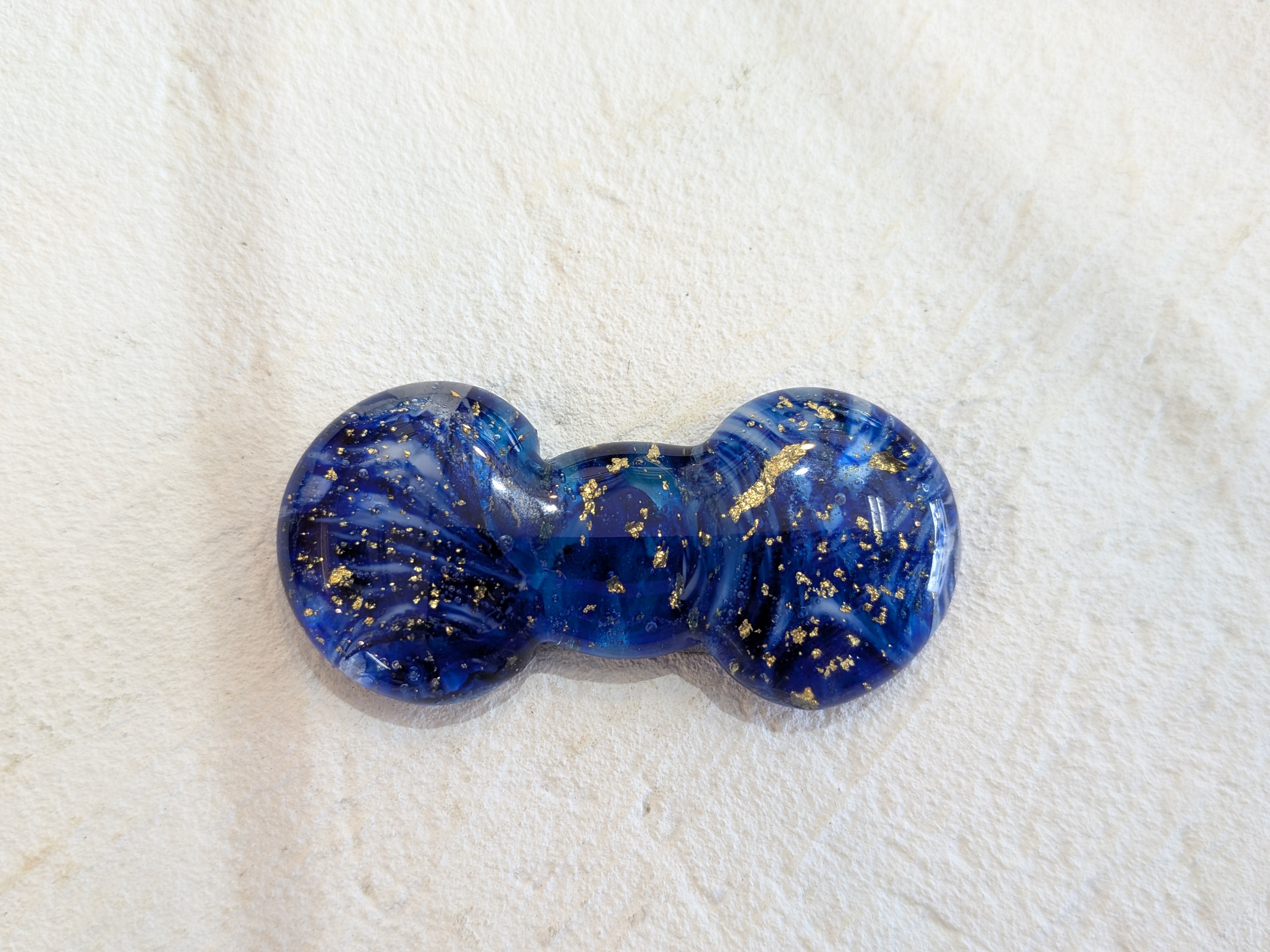
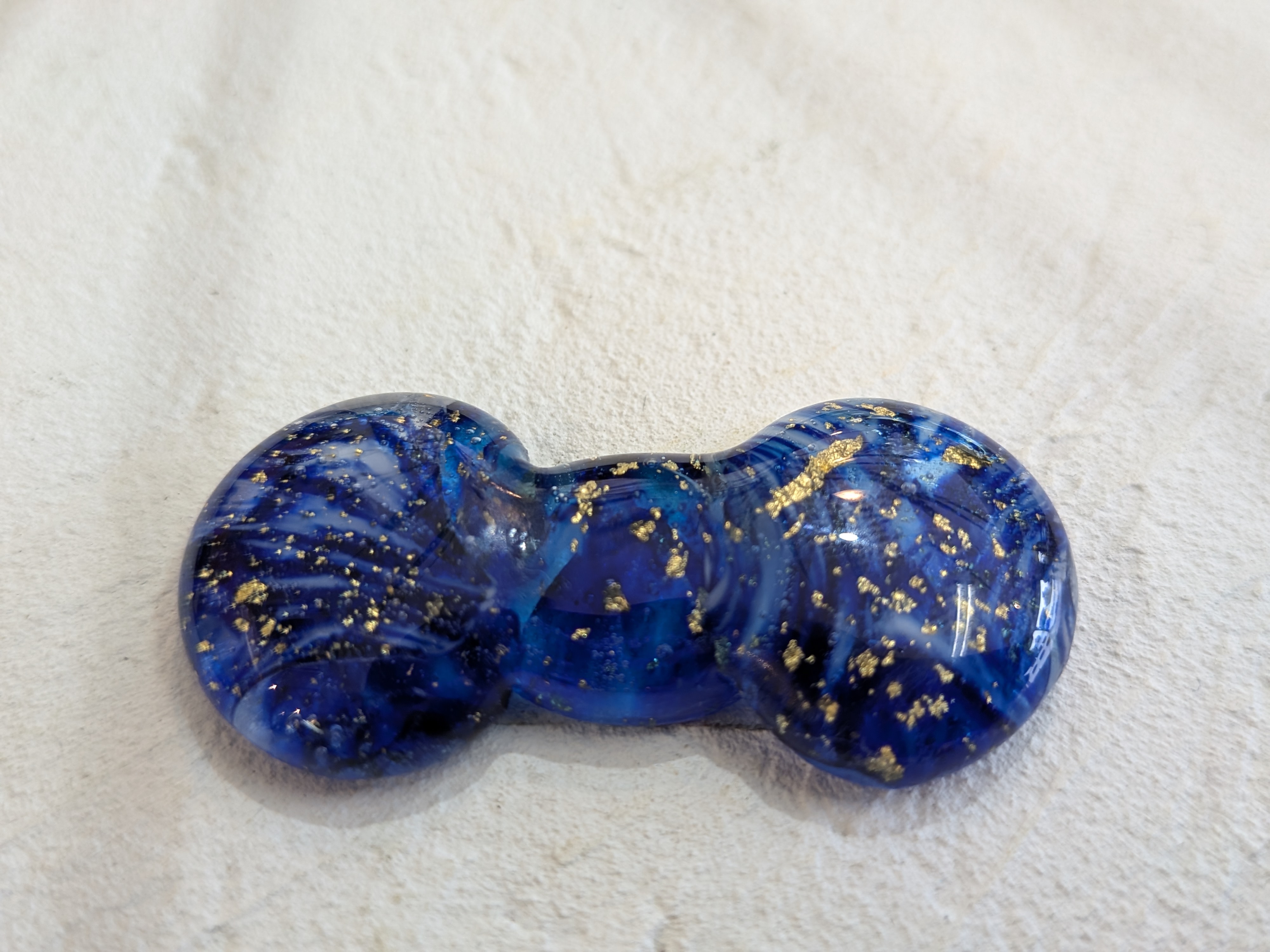
This Earth Edition hand-blown Ryukyu glass chopstick and cutlery rest by Takumi Matsumuro (松室 巧) brings the visual character of Okinawa's coastal waters to the dining table in a compact sculptural form. The distinctive figure-eight or peanut-shaped silhouette creates two rounded lobes connected by a gently shaped central bridge, providing a stable resting point for chopsticks and selected pieces of fine cutlery.
Deep cobalt blue, lapis and optic-white glass move organically through the body, while metallic-gold elements provide luminous accents within the composition. Fine internal bubbles add further depth, catching and scattering light as the piece is viewed from different angles.
Despite its small scale, the rest has a substantial visual presence. Its smooth hand-formed surface, concentrated color movement and gold detailing allow it to function as both a practical table accessory and a small-format example of contemporary Okinawan studio glass.
Takumi Matsumuro & the Takumi Kōbō Tradition
Takumi Matsumuro (松室 巧) is presented with this work as the named artisan associated with the piece and Takumi Kōbō. The work belongs to the Okinawan tradition of Chūfuki (宙吹き) glassmaking, in which molten glass is shaped through blowing, rotation, heating and direct hand manipulation. This free-form approach gives individually made pieces their own variations in color distribution, contours, bubbles and internal movement. For the final collector listing, any specific professional designation, award or certification attributed directly to Matsumuro should be supported by the artist or studio documentation accompanying the work.
Gold, Ocean & Form
The design brings together three principal visual elements:
Cobalt & Lapis Ocean Currents: Deep blue glass creates the dominant visual field, with flowing variations that suggest underwater movement.
Luminous Gold Elements: Gold-leaf details introduce warm metallic highlights against the cooler blue palette.
Sculptural Bridge Form: The paired-lobe construction gives the piece its distinctive silhouette while creating a practical central resting area for chopsticks or appropriate cutlery.
The result is a small object in which function, color and sculptural form are deliberately integrated.
Chūfuki - Free-Form Hand-Blown Glass
Chūfuki (宙吹き) is a traditional free-form mouth-blown glass technique. Rather than being produced from a standardized industrial mold, molten glass is gathered and shaped by the artisan through controlled blowing, rotation, reheating and hand manipulation. For a small object such as this, even subtle changes in the movement of the molten glass can affect the final distribution of color, gold and internal bubbles. Accordingly, individually hand-formed pieces naturally possess variations that make each example visually distinct.
A Small-Format Work of Okinawan Studio Glass
The compact scale makes this Earth Edition piece particularly versatile.
It can be used as:
- A chopstick rest
- A rest for selected table cutlery
- A decorative table accent
- A Japanese dining presentation element
- A collector's display object
- A complementary piece within an Okinawan glass collection
Its strongest visual effect comes from placing it against a simple, neutral table surface where the cobalt, white and gold elements can remain the focus.
Premium Highlights
- Artist: Takumi Matsumuro (松室 巧)
- Studio: Takumi Kōbō (たくみ工房)
- Acquisition: Onna Village, Okinawa
- Technique: Free-form mouth-blown glass (Chūfuki)
- Form: Sculptural chopstick & cutlery rest
- Palette: Deep cobalt blue, lapis, optic white and metallic gold
- Surface Character: Individually formed glass with internal bubble variation
- Gold Detail: Gold-leaf elements, subject to studio/material documentation
- Edition: Earth Edition
- Character: Individually hand-crafted contemporary Okinawan studio glass
Curator's Note
This compact Earth Edition piece demonstrates how Okinawan hand-blown glass can transform an everyday table object into a small sculptural composition.
Deep cobalt and lapis currents evoke the surrounding waters of Okinawa, while luminous gold elements provide a warm contrast against the cooler glass. Its distinctive double-lobed form gives the piece both practical purpose and a strong visual identity.
Placed individually or incorporated into an elegant dining setting, it offers a subtle way to bring contemporary Okinawan glass craftsmanship to the table.
Dimensions & Physical Specifications
Estimated Studio Proportions
| Attribute | Estimated Details |
| Length | ~7.5–8.5 cm |
| Maximum Width | ~3.5–4.2 cm |
| Height / Thickness | ~1.5–2.0 cm |
| Net Weight | ~60–90 g |
| Form | Chopstick / Cutlery Rest |
| Technique | Chūfuki / free-form mouth-blown glass |
| Condition | New/unused studio condition, if confirmed |
For the final product page: I recommend physically measuring the individual piece and replacing these estimated ranges with exact dimensions and weight.
Care Instructions
- Hand wash gently with lukewarm water and mild soap.
- Use a soft microfiber cloth or non-abrasive sponge.
- Avoid abrasive cleaners and scouring pads.
- Do not place in a dishwasher.
- Avoid sudden temperature changes.
- Handle carefully when placing or removing from the dining table.
- Store individually or with sufficient padding to prevent contact with other glass or ceramic objects.
Shipping & International Delivery
Japan: The piece should be individually protected and shipped using an insured service appropriate for fragile studio glass.
International: International delivery can be arranged where available, using protective packaging and insured transportation appropriate to the piece. International customers are responsible for applicable customs duties, import taxes, VAT/GST, brokerage fees and other destination-country charges.
Provenance & Collector Documentation
For the Xandre Store archive, I recommend retaining photographs of:
- The complete chopstick rest
- Top and side views
- Close-up photographs of the gold elements
- Details of the cobalt, lapis and white glass movement
- The underside
- Any identifying studio/maker's mark, if present
- The acquisition location at Takumi Kōbō
- Any accompanying studio documentation or packaging
If documentation specifically identifies Takumi Matsumuro (松室 巧) as the artisan, retain that documentation with the item's provenance record.
Specifications
| Attribute | Details |
| Artist | Takumi Matsumuro (松室 巧) |
| Studio | Takumi Kōbō (たくみ工房) |
| Acquisition Location | Onna Village, Okinawa Prefecture, Japan |
| Category | Hand-Blown Ryukyu Studio Glass / Fine Art Tableware |
| Form | Chopstick & Cutlery Rest |
| Series | Earth Edition |
| Technique | Free-form mouth-blown glass (Chūfuki) |
| Primary Colors | Cobalt blue, lapis, optic white |
| Metallic Detail | Gold-leaf elements |
| Internal Detail | Bubble formations |
| Condition | New/unused studio condition, if confirmed |
| Provenance | Acquired through Takumi Kōbō, Onna Village |
Xandre Store
Connecting global collectors with the heritage, craftsmanship, and stories behind exceptional Japanese and Okinawan studio art.
Two terminology changes I recommend keeping
1. “Chashaku-oki” → remove it.
A chashaku-oki (茶杓置) is specifically a rest for a tea scoop (chashaku), so it isn't the appropriate Japanese term for this object unless it was actually designed for tea-ceremony use.
2. “Authentication” → “identifying studio/maker's mark.”
A physical mark can be important provenance evidence, but it is better not to describe the mark itself as independently authenticating the work unless the studio or another qualified source explicitly establishes that. This keeps the collector language strong while making the provenance statement defensible.
Previously viewed products
No recently viewed products.